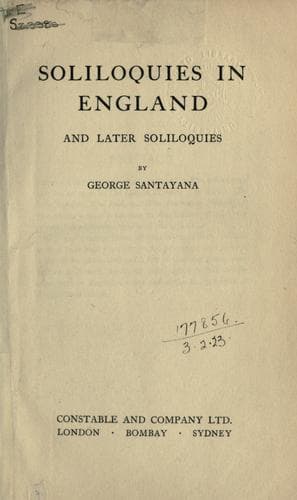
Soliloquies in England, and Later SoliloquiesSantayana, George
Philosophy
Soliloquies in England, and Later Soliloquies
Santayana, George
American essays -- 20th century
When ancient peoples defended what they called their liberty, the word
stood for a plain and urgent interest of theirs: that their cities
should not be destroyed, their territory pillaged, and they themselves
sold into slavery. For the Greeks in particular liberty meant even
more than this. Perhaps the deepest assumption of classic philosophy
is that nature and the gods on the one hand and man on the other, both
have a fixed character; that there is consequently a necessary piety,
a true philosophy, a standard happiness, a normal art. The Greeks
believed, not without reason, that they had grasped these permanent
principles better than other peoples. They had largely dispelled
superstition, experimented in government, and turned life into a
rational art. Therefore when they defended their liberty what they
defended was not merely freedom to live. It was freedom to live well,
to live as other nations did not, in the public experimental study of
the world and of human nature. This liberty to discover and pursue a
natural happiness, this liberty to grow wise and to live in friendship
with the gods and with one another, was the liberty vindicated at
Thermopylae by martyrdom and at Salamis by victory.
As Greek cities stood for liberty in the world, so philosophers stood
for liberty in the Greek cities. In both cases it was the same kind
of liberty, not freedom to wander at hazard or to let things slip,
but on the contrary freedom to legislate more precisely, at least for
oneself, and to discover and codify the means to true happiness. Many
of these pioneers in wisdom were audacious radicals and recoiled from
no paradox. Some condemned what was most Greek: mythology, athletics,
even multiplicity and physical motion. In the heart of those thriving,
loquacious, festive little ant-hills, they preached impassibility and
abstraction, the unanswerable scepticism of silence. Others practised
a musical and priestly refinement of life, filled with metaphysical
mysteries, and formed secret societies, not without a tendency to
political domination. The cynics railed at the conventions, making
themselves as comfortable as possible in the rôle of beggars and
mocking parasites. The conservatives themselves were radical, so
intelligent were they, and Plato wrote the charter of the most extreme
militarism and communism, for the sake of preserving the free state. It
was the swan-song of liberty, a prescription to a diseased old man to
become young again and try a second life of superhuman virtue. The old
man preferred simply to die.
Public-domain text, read in full here on John Shaqi.
Reviews
Reviews
No reviews yet
Be the first to share your thoughts on this work.
Elsewhere in the archive
Join the Discussion
Join the discussion
Sign in to leave a comment or review.
Sign InorCreate an account