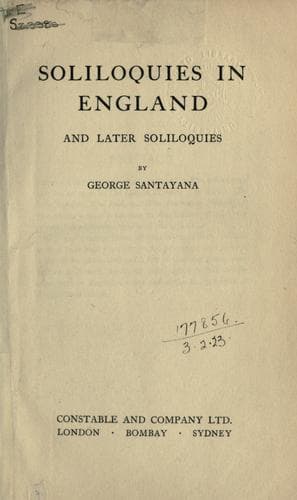
Soliloquies in England, and Later SoliloquiesSantayana, George
Philosophy
Soliloquies in England, and Later Soliloquies
Santayana, George
American essays -- 20th century
When it came to full fruition this orthodox freedom was far from gay;
it was called sanctity. The freedom of pagan philosophers too had
turned out to be rather a stiff and severe pose; but in the Christian
dispensation this austerity of true happiness was less to be wondered
at, since life on earth was reputed to be abnormal from the beginning,
and infected with hereditary disease. The full beauty and joy of
restored liberty could hardly become evident in this life. Nevertheless
a certain beauty and joy did radiate visibly from the saints; and
while we may well think their renunciations and penances misguided or
excessive, it is certain that, like the Spartans and the philosophers,
they got something for their pains. Their bodies and souls were
transfigured, as none now found upon earth. If we admire without
imitating them we shall perhaps have done their philosophy exact
justice. Classic liberty was a sort of forced and artificial liberty, a
poor perfection reserved for an ascetic aristocracy in whom heroism and
refinement were touched with perversity and slowly starved themselves
to death.
Since those days we have discovered how much larger the universe is,
and we have lost our way in it. Any day it may come over us again
that our modern liberty to drift in the dark is the most terrible
negation of freedom. Nothing happens to us as we would. We want peace
and make war. We need science and obey the will to believe, we love
art and flounder among whimsicalities, we believe in general comfort
and equality and we strain every nerve to become millionaires. After
all, antiquity must have been right in thinking that reasonable
self-direction must rest on having a determinate character and knowing
what it is, and that only the truth about God and happiness, if we
somehow found it, could make us free. But the truth is not to be
found by guessing at it, as religious prophets and men of genius have
done, and then damning every one who does not agree. Human nature,
for all its substantial fixity, is a living thing with many varieties
and variations. All diversity of opinion is therefore not founded on
ignorance; it may express a legitimate change of habit or interest. The
classic and Christian synthesis from which we have broken loose was
certainly premature, even if the only issue of our liberal experiments
should be to lead us back to some such equilibrium. Let us hope at
least that the new morality, when it comes, may be more broadly based
than the old on knowledge of the world, not so absolute, not so
meticulous, and not chanted so much in the monotone of an abstracted
sage.
41
GERMAN FREEDOM
Public-domain text, read in full here on John Shaqi.
Reviews
Reviews
No reviews yet
Be the first to share your thoughts on this work.
Elsewhere in the archive
Join the Discussion
Join the discussion
Sign in to leave a comment or review.
Sign InorCreate an account