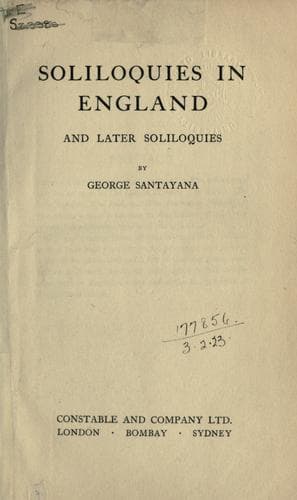
Soliloquies in England, and Later SoliloquiesSantayana, George
Philosophy
Soliloquies in England, and Later Soliloquies
Santayana, George
American essays -- 20th century
There is a fine theory of Hegel's that the universe exists in order
to realize freedom. In Oriental despotisms, he tells us, only one man
was free. In ancient republican cities a minority, the aristocracy
of citizens, obtained freedom. Now at last freedom has extended to
all; not, however, as we might fondly suppose, in free and casual
America, but under the perfect organization of the Prussian monarchy.
For freedom in the mouth of German philosophers has a very special
meaning. It does not refer to any possibility of choice nor to any
private initiative. It means rather that sense of freedom which we
acquire when we do gladly and well what we should have to do anyhow, as
when in passing from a close room into the open air we say we breathe
freely at last. German freedom is like the freedom of the angels in
heaven who see the face of God and cannot sin. It lies in such a deep
love and understanding of what is actually established that you would
not have it otherwise; you appropriate and bless it all and feel it to
be the providential expression of your own spirit. You are enlarged
by sympathy with your work, your country, and the universe, until you
are no longer conscious of the least distinction between the Creator,
the state, and yourself. Your compulsory service then becomes perfect
freedom.
For liberal freedom, for individualism, these philosophers have a
great contempt. They say a man is nothing but the sum of his relations
to other things, and if he should throw off one after another these
constitutive bonds, he would find his private residuum of a self to be
a mathematical point and a naked cipher, incapable of willing or of
choosing anything. And they further say that a dutiful soul is right in
feeling that the world it accepts and co-operates with is its own work;
for, according to their metaphysics, the world is only an idea which
each man makes after his own image, and even as you are, so is the
world you imagine you live in. Only a foolish recalcitrant person, who
does not recognize the handiwork of his own spirit about him, rebels
against it, and thereby cancels his natural freedom; for everywhere he
finds contradictions and closed doors and irksome necessities, being
divided against himself and constantly bidding his left hand undo what
his right hand is doing. So that, paradoxical as it may seem, it is
only when you conform that you are free, while if you rebel and secede
you become a slave. Your spiritual servitude in such a case would only
be manifesting itself in a phenomenal form if the government should put
you in prison.
Public-domain text, read in full here on John Shaqi.
Reviews
Reviews
No reviews yet
Be the first to share your thoughts on this work.
Elsewhere in the archive
Join the Discussion
Join the discussion
Sign in to leave a comment or review.
Sign InorCreate an account