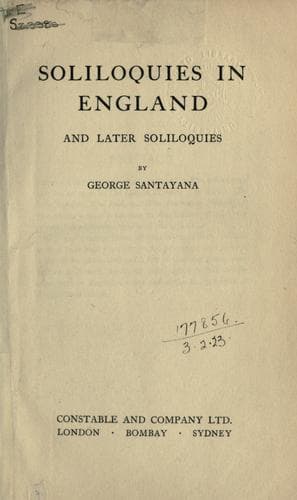
Soliloquies in England, and Later SoliloquiesSantayana, George
Philosophy
Soliloquies in England, and Later Soliloquies
Santayana, George
American essays -- 20th century
The national expression of this kind of freedom is what the Germans
call _Kultur_, a word not well understood in other countries. Every
nation has certain characteristic institutions, certain representative
writers and statesmen, past and present, certain forms of art and
industry, a certain type of policy and moral inspiration. These are
its _Kultur_, its national tradition and equipment. When by education
the individual is brought to understand all these things, to share
their spirit and life, and to be able to carry them forward faithfully,
then he has absorbed the _Kultur_ in his own person. _Kultur_ is
transmitted by systematic education. It is not, like culture, a matter
of miscellaneous private attainments and refined tastes, but, rather,
participation in a national purpose and in the means of executing it.
The adept in this _Kultur_ can live freely the life of his country,
possessing its secret inspiration, valuing what it pursues and finding
his happiness in those successes which he can help it to attain.
_Kultur_ is a lay religion, which includes ecclesiastical religion and
assigns to it its due place.
German _Kultur_ resembles the polity of ancient cities and of the
Christian church in that it constitutes a definite, authoritative,
earnest discipline, a training which is practical and is thought
to be urgent and momentous. It is a system to be propagated and to
be imposed. It is all-inclusive and demands entire devotion from
everybody. At the same time it has this great advantage over the
classic systems, that it admits variations. At Sparta, in Plato's
Republic, and in the Catholic church the aims and constitution of
society were expected to remain always the same. The German ideal,
on the contrary, not only admits evolution, but insists upon it.
Like music, it is essentially a form of movement. According to the
philosophers, however, the form of this movement is fixed by the
absolute genius of the composer, and prescribes the way in which the
changes shall go on. Evolution thus introduces life into this ideal,
but does not admit ambiguities. In this sense the German law of
progression is as inexorable as the classic model of form.
Public-domain text, read in full here on John Shaqi.
Reviews
Reviews
No reviews yet
Be the first to share your thoughts on this work.
Elsewhere in the archive
Join the Discussion
Join the discussion
Sign in to leave a comment or review.
Sign InorCreate an account