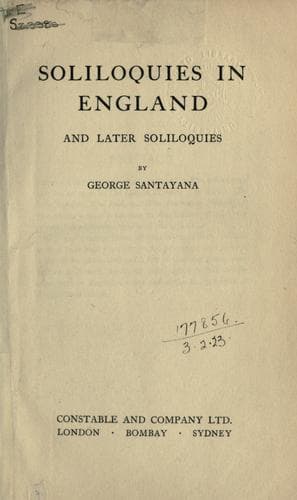
Soliloquies in England, and Later SoliloquiesSantayana, George
Philosophy
Soliloquies in England, and Later Soliloquies
Santayana, George
American essays -- 20th century
In the interval, happiness is not to be found in being a fixed star, as
bright and pure as possible, even if only for a season; happiness is to
flow and dissolve in sympathy with one's higher destiny.
The motion of progress is thus merged with that of universal evolution,
dropping the element of liberty and even of improvement. Nevertheless,
in the political expression of liberalism, liberty took the first
innings. Protestants began by asserting the right of private Judgement
in interpreting scripture; transcendentalists ended by asserting the
divine right of the individual to impose his own spirit on everything
he touched. His duty to himself, which was also his deepest instinct,
was to suck in from the widest possible field all that was congenial to
him, and to reject, down to his very centre, whatever might thwart or
offend. Sometimes he carried his consistency in egotism to the length
of denying that anything he could not digest could possibly exist, or
that the material world and foreign nations were more than ideal pawns
in the game he played with himself for his self-development. Even when
not initiated into these transcendental mysteries, he was filled with
practical self-trust, the desire to give himself freedom, and the
belief that he deserved it. There was no need of exploring anything
he was not tempted to explore; he had an equal right to his opinion,
whatever the limits of his knowledge; and he should be coerced as
little as possible in his action. In specific matters, for the sake of
expediency, he might be willing to yield to the majority; but only when
his vote had been counted, and as a sort of insurance against being
disturbed in his residual liberty.
There was a general conviction behind all these maxims, that tradition
corrupts experience. All sensation--which is the test of matters of
fact--is somebody's sensation; all reasoning is somebody's reasoning,
and vitally persuasive as it first comes; but when transmitted the
evidence loses its edge, words drop their full meaning, and inert
conventions falsify the insights of those who had instituted them.
Therefore, reform, revision, restatement are perpetually required: any
individual, according to this view, who honestly corrected tradition
was sure to improve upon it. Whatsoever was not the fresh handiwork
of the soul and true to its present demand was bad for that soul. A
man without traditions, if he could only be materially well equipped,
would be purer, more rational, more virtuous than if he had been an
heir to anything. _Weh dir, dass du ein Enkel bist_! Blessed are the
orphans for they shall deserve to have children; blessed the American!
Philosophy should be transcendental, history romantic and focussed in
one's own country, politics democratic, and art individual and above
convention. Variety in religious dogma would only prove the truth--that
is, the inwardness--of inspiration.
Public-domain text, read in full here on John Shaqi.
Reviews
Reviews
No reviews yet
Be the first to share your thoughts on this work.
Elsewhere in the archive
Join the Discussion
Join the discussion
Sign in to leave a comment or review.
Sign InorCreate an account