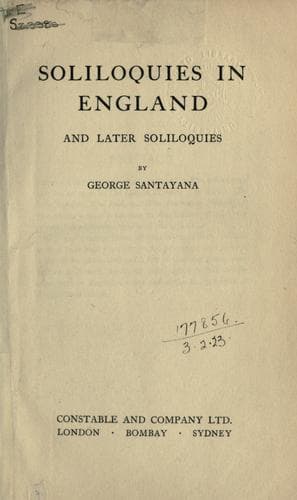
Soliloquies in England, and Later SoliloquiesSantayana, George
Philosophy
Soliloquies in England, and Later Soliloquies
Santayana, George
American essays -- 20th century
habits and devilish instincts, that true freedom for him can only
come of correcting himself, until he has learned to find happiness in
virtue--plainly that would be to abandon liberalism, and to preach
the classical doctrine that the good is not liberty but wisdom.
Liberalism was a protest against just such assumptions of authority. It
emphatically refused to pursue an eventual stoical freedom, absurdly
so called, which was to come when we had given up everything we really
wanted--the mock freedom of service. In the presence of the little boy
liberal philosophy takes a middle course. It is convinced--though it
would not do to tell him so prematurely--that he must be allowed to
go dirty for a time, until sufficient experience of filth teaches him
how much more comfortable it is to be clean; also that he will go to
school of his own accord if the books have pictures enough in them, and
if the teacher begins by showing him how to make superior mud-pies.
As to morals and religion, the boy and his companions will evolve the
appropriate ones in time out of their own experience, and no others
would be genuine.
Liberal philosophy, at this point, ceases to be empirical and British
in order to become German and transcendental. Moral life, it now
believes, is not the pursuit of liberty and happiness of all sorts by
all sorts of different creatures; it is the development of a single
spirit in all life through a series of necessary phases, each higher
than the preceding one. No man, accordingly, can really or ultimately
desire anything but what the best people desire. This is the principle
of the higher snobbery; and in fact, all earnest liberals are higher
snobs. If you refuse to move in the prescribed direction, you are not
simply different, you are arrested and perverse. The savage must not
remain a savage, nor the nun a nun, and China must not keep its wall.
If the animals remain animals it is somehow through a failure of the
will in them, and very sad. Classic liberty, though only a name for
stubborn independence, and obedience to one's own nature, was too
free, in one way, for the modern liberal. It accepted all sorts of
perfections, animal, human, and divine, as final after their kind, each
the seat of a sufficient virtue and happiness. It was polytheistic.
Between master and slave, between man and woman, it admitted no moral
advance or development; they were, or might be, equally perfect.
Inequality was honourable; amongst the humblest there could be dignity
and sweetness; the higher snobbery would have been absurd, because if
you were not content to be what you were now, how could you ever be
content with anything? But the transcendental principle of progress
is pantheistic. It requires everything to be ill at ease in its own
house; no one can be really free or happy but all must be tossed, like
herded emigrants, on the same compulsory voyage, to the same unhomely
destination. The world came from a nebula, and to a nebula it returns.
Public-domain text, read in full here on John Shaqi.
Reviews
Reviews
No reviews yet
Be the first to share your thoughts on this work.
Elsewhere in the archive
Join the Discussion
Join the discussion
Sign in to leave a comment or review.
Sign InorCreate an account