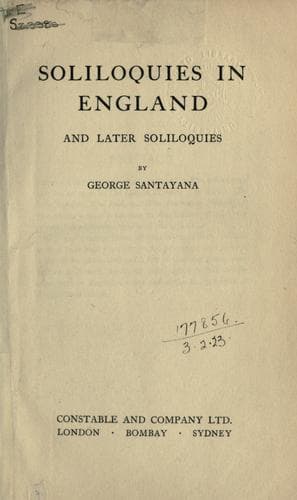
Soliloquies in England, and Later SoliloquiesSantayana, George
Philosophy
Soliloquies in England, and Later Soliloquies
Santayana, George
American essays -- 20th century
again in his master's stables, lounge at the public-house, and bounce
his children on his knee amongst the hollyhocks before his cottage.
Would the demagogues give him better prospects, or prove better
masters? Would he be happier with no masters at all? Consider the
demagogues themselves, and their history. They found themselves in the
extreme of misery; but even this is a sort of distinction, and marks
off a new species, seizing new weapons in the struggle for existence.
The scum of the earth gathers itself together, becomes a criminal or
a revolutionary society, finds some visionary or some cosmopolitan
agitator to lead it, establishes its own code of ethics, imposes the
desperate discipline of outlaws upon its members, and prepares to rend
the free society that allowed it to exist. It is astonishing with
what docility masses of Englishmen, supposed to be jealous of their
personal liberty, will obey such a revolutionary junta, that taxes and
commands them, and decrees when they shall starve and when they shall
fight. I suspect that the working-people of the towns no longer have
what was called the British character. Their forced unanimity in action
and passion is like that of the ages of faith; its inspiration, like
that of early Christianity, comes from a few apostles, perhaps foreign
Jews, men who in the beginning had visions of some millennium; and the
cohesion of the faithful is maintained afterwards by preaching, by
custom, by persecution, and by murder. Yet it is intelligible that the
most earnest liberals, who in so far as they were advocates of liberty
fostered these conspiracies, in so far as they are philanthropists
should applaud them, and feel the need of this new tyranny. They save
liberal principles by saying that they applaud it only provisionally as
a necessary means of freeing the people. But of freeing the people from
what? From the consequences of freedom.
44
JOHN BULL AND HIS PHILOSOPHERS
Public-domain text, read in full here on John Shaqi.
Reviews
Reviews
No reviews yet
Be the first to share your thoughts on this work.
Elsewhere in the archive
Join the Discussion
Join the discussion
Sign in to leave a comment or review.
Sign InorCreate an account