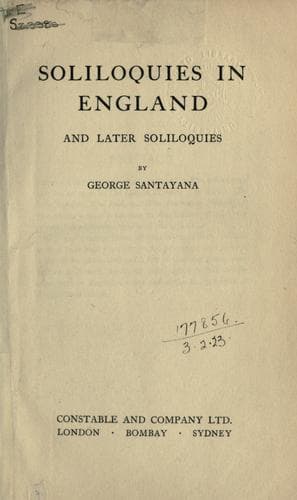
Soliloquies in England, and Later SoliloquiesSantayana, George
Philosophy
Soliloquies in England, and Later Soliloquies
Santayana, George
American essays -- 20th century
England has been curiously served by her philosophers. Personally and
in their first intention they have usually been sturdy Britons; but
their scope has seldom been equal to their sagacity in particular
matters, they have not divined the ultimate drift of their ideas, and
they have often ended by adopting, a little blankly and doggedly, some
foreign or fantastic system, apparently most inexpressive of John Bull.
Nevertheless the exotic tendency in so many British philosophers, as
in so many disaffected British poets, is itself a mark of the British
character. The crust of convention has solidified too soon, and the
suppressed fires issue in little erratic streams that seem of an alien
substance. In speculation as in other things the Englishman trusts
his inner man; his impulse is to soliloquize even in science. At the
same time his inner man dislikes to be too articulate; he is soon at a
stand in direct self-expression; and as a poet may take to describing
nature or Italian passions, so a philosopher may pick up some alien
doctrine that comes to hand, and that seems friendly to his mind; not
understanding it very well, perhaps, in its native quality, but making
it a living companion in his own lucubrations, and a symbol for what
remains hidden but revered in his breast. In this way the Bible or
Plato may serve him to found sects upon exclusively expressing his own
feelings; or remaining a plain Englishman to all practical purposes,
he may become, for his greater private satisfaction, a revolutionary
atheist, a spiritualist, a Catholic, or a Buddhist. In such strange
allegiances something may be due to wayward learning, or to genuine
plasticity of mind and power to feel as very different souls have felt
in other climes; but a part is unmistakable helplessness and dire need,
and a part, perhaps, affectation.
When his own resources fail, however, the most obvious easement and
support for the English inner man are the classical and Anglican
traditions he has been bred in, when these are not too nicely defined
nor too slavishly followed. Most characteristic is John Bull the
theologian, instinct with heresy and practising compromise; but the
rationalistic John Bull is very like him in his alternative way of
securing the same supreme object of thinking what he likes to think.
In both cases he embraces his opinions much more because they are
wholesome and important than because they are certain or clear.
Opinions, he feels, should be summary and safe; they should express the
lessons of experience.
Public-domain text, read in full here on John Shaqi.
Reviews
Reviews
No reviews yet
Be the first to share your thoughts on this work.
Elsewhere in the archive
Join the Discussion
Join the discussion
Sign in to leave a comment or review.
Sign InorCreate an account