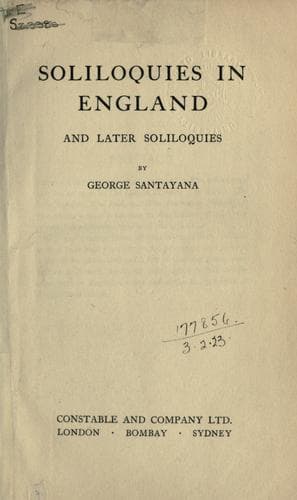
Soliloquies in England, and Later SoliloquiesSantayana, George
Philosophy
Soliloquies in England, and Later Soliloquies
Santayana, George
American essays -- 20th century
it; and as for us, if we possess such cursory knowledge of the nearer
parts of existence as is sufficient for our safety, there is no reason
why we should attend to it too minutely: there's metal more attractive
in discourse and in fiction. Mind, as Hobbes said, is fancy, and it is
the things of fancy that greet us first and reward us best. They are
far from being more absurd than the facts. In themselves, all things
are equally unnecessary and equally possible; for their own part, all
are equally ready to be thought of or even to be born. It is only the
routine of nature or the sluggish human imagination that refuses to
admit most of them, as country people refuse to admit that foreign
languages or manners might do as well as their own.
If God or nature had used Occam's razor and had hesitated to multiply
beings without necessity, where should _we_ be? Far from practising
economy, nature is prevented from overflowing into every sort of
flourish and excrescence only by the local paucity of matter, or the
pre-emption of it by other forms; because forms, once embodied in
matter, acquire all its inertia, and grow dreadfully stubborn and
egotistical. Scrimpy philosophers little know whose stewards they
are when they complain of lavishness in nature, or her lordly way
of living; her substance cannot be spent, nor its transformations
exhausted. In sheer play, and without being able to help it, she will
suddenly create organization, or memory, or intelligence, or any of
those little vortices called passions, persons, or nations, which
sustain themselves for a moment, hypostatizing their frail unity into
some moral being--an interest or a soul. And as we are superfluous in
the midst of nature, so is the best part of ourselves superfluous in
us. Poetry, music and pictures, inspired and shaded by human emotion,
are surely better worth having than the inarticulate experience they
spring from. Even in our apprehension of the material world, the best
part is the adaptation of it to our position and faculties, since this
is what introduces boundaries, perspectives, comparison and beauty.
It is only what exists materially that exists without excuse, whereas
what the mind creates has some vital justification, and may serve to
justify the rest. Hence the utility of Occam's razor itself, which may
help us to arrive at a strict and spare account of what the world would
be without us: a somewhat ironical speculation which is the subtlest
product and last luxury of the scientific mind. Meantime the sensuous
and rhetorical trappings of human knowledge, from which exact science
abstracts, by no means disappear; they remain to enrich the sphere of
language and fancy, to which judicious people always felt that they
belonged; and this intellectual or literary realm is no less actual and
interesting than any other, being a part of the moral radiation and
exuberance of a living world.
46
EMPIRICISM
Public-domain text, read in full here on John Shaqi.
Reviews
Reviews
No reviews yet
Be the first to share your thoughts on this work.
Elsewhere in the archive
Join the Discussion
Join the discussion
Sign in to leave a comment or review.
Sign InorCreate an account