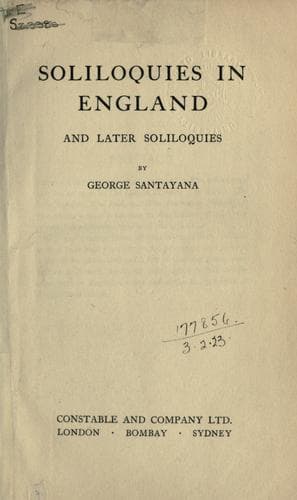
Soliloquies in England, and Later SoliloquiesSantayana, George
Philosophy
Soliloquies in England, and Later Soliloquies
Santayana, George
American essays -- 20th century
Occam's razor has gradually shorn British and German philosophy of the
notions of substance and cause, matter and God, truth and the soul.
Sometimes these terms were declared to stand for nothing whatever,
because (as in the case of matter and substance) if I reduced myself to
a state of artificial stupidity I might for a moment stop short of the
conception of them. More often (as in the case of the soul) the term
was declared to stand for something real, which, however, was "nothing
but" something else. Of course, all words and thoughts stand for
something else; and the question is only whether we can find another
word or thought that will express the reality better. Thus, if I said
that the soul was "nothing but" a series of sensations, I should soon
have to add that this series, to make up a soul, must arise in the
same animal body, and must be capable of being eventually surveyed and
recalled together; while I should have to assign to some other obscure
agency those unconscious vital functions which were formerly attributed
to the soul in forming and governing the body, and breeding the
passions; functions without which my series of sensations would hardly
be what it is. I am not confident that all this laboured psychology
makes things much clearer in the end, or does not multiply entities
without necessity; since where I had simply spoken of the soul, I
should now have to speak of sensations, series, possibility, synthesis,
personal identity, the transcendental unity of apperception, and the
unconscious mind. Something is doubtless gained by coining these modern
and questionable expressions, since they indicate true complexities in
the facts, while a poetic term like "soul" covers them only by pointing
the finger of childish wonder at them, without analysis. Nature is
far more complicated than any language or philosophy, and the more
these refine, the closer they can fit. The anxiety of the honest Occam
to stick to the facts, and pare his thoughts to the quick, had this
justification in it, that sometimes our images and distinctions are
misplaced. Grammar, usurping the rôle of physics, created metaphysics,
the trouble with which is not at all that it multiplies entities, since
no metaphysician can invent anything that did not lie from all eternity
in the realm of essence, like the plot of unwritten novels, waiting
for some one with wit enough to think of it. The trouble is rather
that the metaphysician probably gives his favourite essences the wrong
status. These beings may well be absent from the time and place to
which he hastily assigns them; they may even be incongruous altogether
with what happens to exist anywhere. What happens to exist is perhaps
what he thinks he is describing, or what, like Occam, he would like to
describe if he could; but he is probably not able. Yet that doesn't
matter so much as he imagines. What happens to exist can take very
good care of itself, and is quite indifferent to what people think of
Public-domain text, read in full here on John Shaqi.
Reviews
Reviews
No reviews yet
Be the first to share your thoughts on this work.
Elsewhere in the archive
Join the Discussion
Join the discussion
Sign in to leave a comment or review.
Sign InorCreate an account