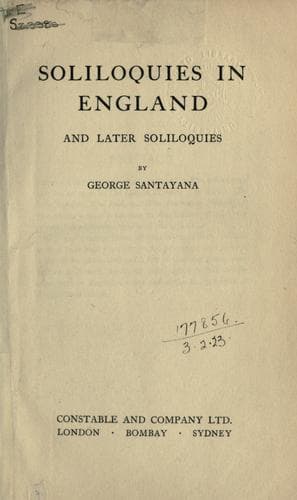
Soliloquies in England, and Later SoliloquiesSantayana, George
Philosophy
Soliloquies in England, and Later Soliloquies
Santayana, George
American essays -- 20th century
It was formerly a matter of some surprise to me that there should be
so many Hegelians in England, and in such places of influence. I could
imagine how the system might have taken root in circles where the
classic tradition was absent or enfeebled--in America, in Scotland,
among the Dissenters or Jews in England itself; but how could Oxford
and Cambridge fail to see in that system the trail of the serpent? How
could they mistake it for a Christian or for a spiritual philosophy? It
is indeed, in form, an encyclopaedic system, and in that sense suitable
to universities; and it deifies knowledge such as an encyclopaedia can
give, turning it into the sum total of reality, so that it flatters
the self-sufficiency of pedants, or that of any reflective mind. But
in Oxford and Cambridge knowledge is not everything; they are more and
less than universities; the learning they cultivate is selective and
pursued in the service of aristocratic liberty. I should not expect
them to care much for a philosophy that was not poetic and devout. I
sometimes fancy how the genuine Oxonians must have smiled to hear T.
H. Green, in the early days of transcendentalism, talking about his
spiritual principle in nature. By spiritual he meant mind-made; he
thought the world, remaining just as it is, could suddenly be proved to
be spiritual if you could show that a mental synthesis was requisite
to hold it together. But what possible advantage is it to the world to
be held together by a mental synthesis, rather than by space or time
or the truth of its constitution? A synthesis of worthless facts does
not render them severally better, nor itself a good. A spirit whose
essential function was to create relations would be merely a generative
principle, as the spider is to its web; it would be no better than its
work, unless perhaps it was spiritual enough to grow weary of that vain
labour. Spiritual, for those who retain the language of Christendom,
signifies free from the world and from the flesh, and addressed to the
eternal and to the beautiful.
Public-domain text, read in full here on John Shaqi.
Reviews
Reviews
No reviews yet
Be the first to share your thoughts on this work.
Elsewhere in the archive
Join the Discussion
Join the discussion
Sign in to leave a comment or review.
Sign InorCreate an account