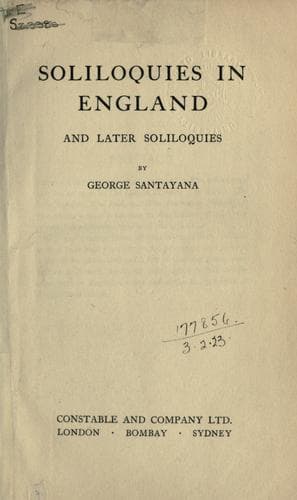
Soliloquies in England, and Later SoliloquiesSantayana, George
Philosophy
Soliloquies in England, and Later Soliloquies
Santayana, George
American essays -- 20th century
Everything, however, has its explanation, and in the matter of English
Hegelism I think I begin to see it. In the first place, I was rashly
identifying England with a figment of my dreams, with which I was
in love: I saw in my mind's eye a manly and single-minded England,
free, candid, poetical, akin to feudal France, beauty-loving like
old Italy, the Benjamin of the Roman family of nations, adding to
the dignity and disinterestedness of the Castilian character only a
certain blond charm, a certain infusion of northern purity, and of
sympathy with the wild and rural voices of nature. In this England,
in which there was something Spartan and archaically Greek, the men
were like Hippolytus and the women like Antigone. Naturally it was
unintelligible to me that the system of Hegel should take root in such
a nation. Persons with a ripe moral tradition are not attracted by
sophistry. No argument, however specious, will convince them that the
experience of man on earth makes up the whole universe, or the chief
part of it; much less will they allow fortune, under the pompous name
of evolution, to dictate to them their moral allegiance. The chief
force of the Hegelian system for those who are not metaphysicians lies
in the criterion of progress which it imposes. This criterion is not
beauty in art, nor truth in philosophy, nor justice in society, nor
happiness in the individual life: the criterion is simply the direction
which the actual movement happens to be taking. Hegel endeavours to
show in what way forms are inevitably passing into one another. Thus
his ethics begs defence of history, and his history calls for aid on
metaphysics. And what metaphysics? A logic of moral fashions. Now it
seemed to me axiomatic that eager co-operation with whatever is going
on, or is bound to win, would be repulsive to a man of honour. Nor
could I conceive a true Englishman taking kindly even to the grand side
of this system, which to me personally is rather attractive, I mean
to its satirical elevation. The English mind is tender and temperate:
it deprecates scorn. But Hegel, in his scathing moods, is comparable
to Heraclitus; he mocks every opinion with an opinion which refutes
it, and every life with another life which kills it. He has the wisdom
of the serpent; but unlike Heraclitus, whose fabled tears were warm,
he has the heart of the serpent too. He despises finitude because it
is weak, as if an infinity of pervasive weakness were strong, or a
perpetual flux a victory for anything. Laughing, I can't help thinking,
up his sleeve, he suggests that this flux itself is a victory for the
spirit, meaning by spirit the law by which he supposes that this flux
is controlled. But this is sheer mockery: the only moral victory is
that achieved, under favourable conditions, by some living spirit,
glad to be expressed or to have been expressed in some perfect form.
The finite only is good: the infinite tides are worth exactly what
they cast up.
Public-domain text, read in full here on John Shaqi.
Reviews
Reviews
No reviews yet
Be the first to share your thoughts on this work.
Elsewhere in the archive
Join the Discussion
Join the discussion
Sign in to leave a comment or review.
Sign InorCreate an account