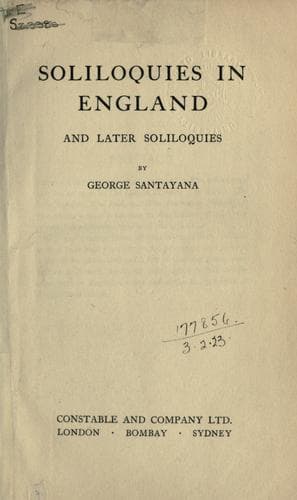
Soliloquies in England, and Later SoliloquiesSantayana, George
Philosophy
Soliloquies in England, and Later Soliloquies
Santayana, George
American essays -- 20th century
Nor is this all; for strange as it may seem, Hegel appeals also to one
type of religious people, and seems to them to lift religious faith
triumphantly above all possible assaults of fact or of science. Are
not all facts mere ideas? And must not all ideas be bred in the mind
according to its own free principles of life and effort? Is not all
this semblance of externality in things a blessed foil to spiritual
activity? Does not this universal mutation pay loud homage to eternal
law? Things go by threes: that is the reason why they exist and why
they move, and the sovereign good to be attained by their motion. If
every truth turns out to be a lie, every lie is a part of some higher
truth; if everything becomes unreal, because it passes into something
else, this other thing inherits its reality; and if we look at things
as a whole instead of _seriatim_, and spread out our moving film into a
panorama, we perceive that everything has implied everything else from
the beginning, and formed a part of it; So that only from the point
of view of ignorance is anything earlier, or better, or truer than
anything else. Here, in the All, we have rest from our labours.
In this way even the slaves of the world at last learn to overcome the
world; but it is too late. This All, even if it were open to human
survey, would have no value: it defeats each of its constituent lives
and is itself responsive to no living desire. The indistinction which
the vague idea of it produces in the mind may be soothing to the weary;
but better than mystical relief at the end would have been moral
freedom in the beginning. That a different life will supersede mine is
nothing against my happiness; that time is swallowing me up is nothing
against my appropriate eternity. How vain the crabbed hand of the miser
stringing his pearls and never looking at them, counting the drops
that trickle into his cup and never emptying it, never feeling the
intoxication of living now, of telling the truth frankly, and of being
happy here I If the devil laughs at me because I am mortal, I laugh at
him for imagining that death can trouble me, or any other free spirit,
so long as I live, or after I am dead.
48
THE PROGRESS OF PHILOSOPHY
Public-domain text, read in full here on John Shaqi.
Reviews
Reviews
No reviews yet
Be the first to share your thoughts on this work.
Elsewhere in the archive
Join the Discussion
Join the discussion
Sign in to leave a comment or review.
Sign InorCreate an account