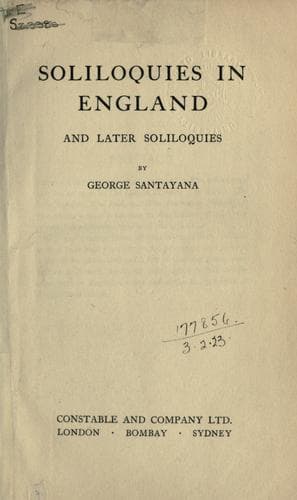
Soliloquies in England, and Later SoliloquiesSantayana, George
Philosophy
Soliloquies in England, and Later Soliloquies
Santayana, George
American essays -- 20th century
This war will kill the belief in progress, and it was high time.
Progress is often a fact: granted a definite end to be achieved, we may
sometimes observe a continuous approach towards achieving it, as for
instance towards cutting off a leg neatly when it has been smashed;
and such progress is to be desired in all human arts. But _belief_
in progress, like belief in fate or in the number three, is a sheer
superstition, a mad notion that because some idea--here the idea of
continuous change for the better--has been realized somewhere, that
idea was a power which realized itself there fatally, and which must
be secretly realizing itself everywhere else, even where the facts
contradict it. Nor is belief in progress identical with belief in
Providence, or even compatible with it. Providence would not have begun
wrong in order to correct itself; and in works which are essentially
progressive, like a story, the beginning is not worse than the end, if
the artist is competent.
What true progress is, and how it is usually qualified by all sorts
of backsliding and by incompatible movements in contrary directions,
is well illustrated by the history of philosophy. There has been
progress in it; if we start with the first birth of intelligence and
assume that the end pursued is to understand the world, the progress
has been immense. We do not understand the world yet; but we have
formed many hypotheses about it corroborated by experience, we are
in possession of many arts which involve true knowledge, and we have
collated and criticized--especially during the last century--a great
number of speculations which, though unverified or unverifiable,
reveal the problems and the possibilities in the case; so that I think
a philosopher in our day has no excuse for being so utterly deceived
in various important matters as the best philosophers formerly were
through no fault of theirs, because they were misled by a local
tradition, and inevitably cut off from the traditions of other ages and
races. Nevertheless the progress of philosophy has not been of such a
sort that the latest philosophers are the best: it is quite the other
way. Philosophy in this respect is like poetry. There is progress in
that new poets arise with new gifts, and the fund of transmitted poetry
is enriched; but Homer, the first poet amongst the Greeks, was also
the best, and so Dante in Italy, and Shakespeare in England. When a
civilization and a language take shape they have a wonderful vitality,
and their first-fruits are some love-child, some incomparable creature
in whom the whole genius of the young race bursts forth uncontaminated
and untrammelled. What follows is more valuable in this respect or
in that; it renders fitly the partial feelings and varying fashions
of a long decadence; but nothing, so long as that language and that
tradition last, can ever equal their first exuberance. Philosophy
is not so tightly bound as poetry is to language and to local
Public-domain text, read in full here on John Shaqi.
Reviews
Reviews
No reviews yet
Be the first to share your thoughts on this work.
Elsewhere in the archive
Join the Discussion
Join the discussion
Sign in to leave a comment or review.
Sign InorCreate an account