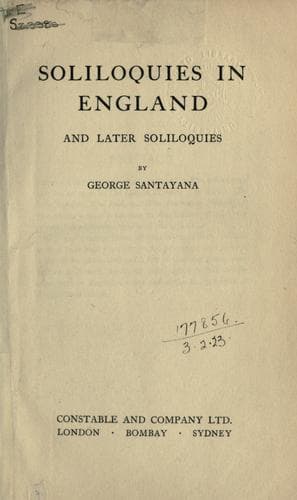
Soliloquies in England, and Later SoliloquiesSantayana, George
Philosophy
Soliloquies in England, and Later Soliloquies
Santayana, George
American essays -- 20th century
Sanity, thy name is Greece. The Greek naturalists saw (what it needs
only sanity to see) that the infinite substance of things was instinct
with a perpetual motion and rhythmic order which were its life, and
that the spirit of man was a spark from that universal fire. They made
a magnificent beginning in understanding what the order of nature is,
and what is the relation of its substance to its spirit. They were much
nearer in their outlook and their wisdom to the Indians than we are
apt to imagine. The Indians meant to be naturalists too; all serious
philosophers must somehow make a naturalism of their chosen elements;
only the Indians were carried away by an untutored imagination. The
Greeks, for their part, also meant to be discerners of substance like
the Indians, and sharers in the divine life. The object which they
believed in and studied was precisely the same as that which the
Indians felt to be breathing deeply around and within them: it was the
infinite substance and life of things; all things not as they appear
but as they truly are. This is the object which animals envisage in
their perceptions from the beginning. The sciences, and all honest
speculation, only substitute more refined ideas for the images of
sense, to be descriptions of the same objects which the images of sense
reveal. The notion that the object of sense is the very image created
in sensation, or is an idea constructed afterwards by the intellect, is
an aberration of confused psychologists; the intellectual construction,
like the sensuous image, is and is meant to be only a symbol for the
substance, whatever it may be, which confronts the living being when
he eats or looks or frames a scientific hypothesis. Natural things, in
their undiscovered inner texture, are the only things-in-themselves,
and the object of every practical perception is the thing-in-itself,
whatever its nature may happen to be.
Public-domain text, read in full here on John Shaqi.
Reviews
Reviews
No reviews yet
Be the first to share your thoughts on this work.
Elsewhere in the archive
Join the Discussion
Join the discussion
Sign in to leave a comment or review.
Sign InorCreate an account