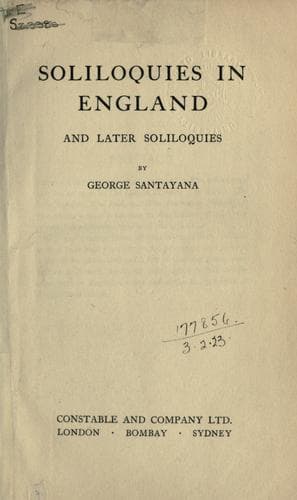
Soliloquies in England, and Later SoliloquiesSantayana, George
Philosophy
Soliloquies in England, and Later Soliloquies
Santayana, George
American essays -- 20th century
inevitable in the Indian system, and dramatically right. The spirit,
left to its own fond logic, remains perfectly ignorant of its natural
ancestry and cannot imagine why it finds itself caught in the vice of
existence, and hanging like Prometheus on a crag of Caucasus, or like
Christ on the cross. The myth of reincarnation, whilst it meets certain
moral demands, leaves the problem essentially untouched. Why should
spirit have fallen in the first instance, or made any beginning in sin
and illusion?
It would have been better, for the moral and religious purposes of
these sages, to have observed and respected the prose facts, and
admitted that each little spirit falls for the first time when the
body is generated which it is to dwell in. It never, in fact, existed
before; it is the spirit of that body. Its transcendental prerogatives
and its impersonal aims are by no means inconsistent with that humble
fact: they seem inconsistent only to those who are ignorant of the
life and fertility of nature, which breeds spirit as naturally as the
lark sings. Aspiration to liberate spirit from absorption in finite
existence is in danger of missing its way if it is not enlightened by a
true theory of existence and of spirit; for it is utterly impossible
to free the spirit materially, since it is the voice of matter, but
by a proper hygiene it can be freed ideally, so that it ceases to be
troubled by its sluggish instrument, or conscious of it. In these
matters the Indians were the sport of the wildest fancy. They mistook
their early poetry for a metaphysical revelation, and their philosophy
was condemned to turn in the most dreary treadmill of commentaries
and homilies, without one ray of criticism, or any revision of first
principles. Nevertheless, all their mythology and scholasticism did
not invalidate (as they did not in the Catholic church afterwards) the
initial spiritual insight on which their system rested. The spirit,
viewed from within, is omnipresent and timeless, and must be spoken of
as falling, or coming down, or entering (as Aristotle puts it) through
the house-door. Spirit calls itself a stranger, because it finds the
world strange; and it finds the world strange because, being the spirit
of a very high-strung and perilously organized animal, it is sensitive
to many influences not harmonious with its own impulses, and has to beg
its daily bread. Yet it is rich in resource; and it gives itself out
for a traveller and tells marvellous lies about its supposed native
land, where it was a prince and an omnipotent poet. These boasts serve
the spirit as a declaration of independence, and a claim to immense
superiority above the world. This independence, however, is really only
the independence of ignorance, that must think and act at random; and
the spirit would add sanity to its spirituality if it recognized the
natural, precarious, and exquisite life of which it is the spirit.
Public-domain text, read in full here on John Shaqi.
Reviews
Reviews
No reviews yet
Be the first to share your thoughts on this work.
Elsewhere in the archive
Join the Discussion
Join the discussion
Sign in to leave a comment or review.
Sign InorCreate an account