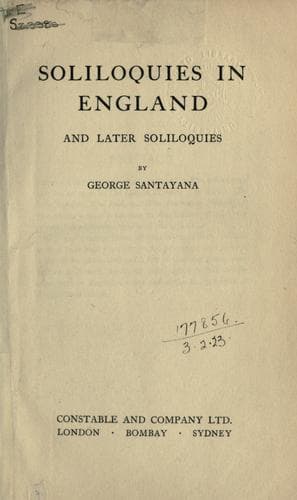
Soliloquies in England, and Later SoliloquiesSantayana, George
Philosophy
Soliloquies in England, and Later Soliloquies
Santayana, George
American essays -- 20th century
Taken for what they really are, these humanistic philosophies express
different sides of human nature. The best (and earliest) is the
Platonic, because the side of human nature which it expresses and
fosters is the spiritual side. Platonic metaphysics projects into
the universe the moral progress of the soul. It is like a mountain
lake, in which the aspirations and passions of a civilized mind are
reflected upside down; and a certain tremor and intensity is added to
them in that narrower frame, which they would hardly have in the upper
air. This system renders the life of the soul more unified and more
beautiful than it would otherwise be. Everything becomes magical, and a
sort of perpetual miracle of grace; the forms which things wear to the
human mind are deputed to be their substance; the uses of life become
its protecting gods; the categories of logic and of morals become
celestial spheres enclosing the earth. A monstrous dream, if you take
it for a description of nature; but a suitable allegory by which to
illustrate the progress of the inner life: because those stages, or
something like them, are really the stages of moral progress for the
soul.
The British and German philosophies belong to an analytic phase of
reflection, without spiritual discipline, and their value is merely
psychological. Their subject matter is human knowledge; and the titles
of many of the chief works of this school confess that this is their
only theme. Not moral life, much less the natural world, but simply the
articulation of knowledge occupies them; and yet, by the hocus-pocus
of metaphysics, they substitute this human experience for the whole
universe in which it arises. The universe is to be nothing but a
flux of perceptions, or a will positing an object, or a tendency to
feign that there is a world. It would ill become me, a pupil of this
philosophy, to deny its profundity. These are the heart-searchings of
"a creature moving about in worlds not realized." It is a wonderful
thing to spin out in soliloquy, out of some unfathomed creative
instinct, the various phases of one's faith and sensibility, making
an inventory of one's intellectual possessions, with some notes on
their presumable or reported history. I love the lore of the moral
antiquary; I love rummaging in the psychological curiosity shop. The
charm of modern life is ambiguous; it lies in self-consciousness.
Egotism has its tender developments; there is a sort of engaging purity
in its perplexities and faithful labours. The German soul has a great
volume, and Hamlet is heroic even in his impotence. When in this little
glow-worm which we call man there is so much going on, what must not
all nature contain in its immensity? Yet all these advances in analysis
and in psychological self-knowledge, far from enriching the modern
philosopher and giving him fresh hints for the interpretation of the
great world, have been neutralized, under the guise of scepticism, by
Public-domain text, read in full here on John Shaqi.
Reviews
Reviews
No reviews yet
Be the first to share your thoughts on this work.
Elsewhere in the archive
Join the Discussion
Join the discussion
Sign in to leave a comment or review.
Sign InorCreate an account