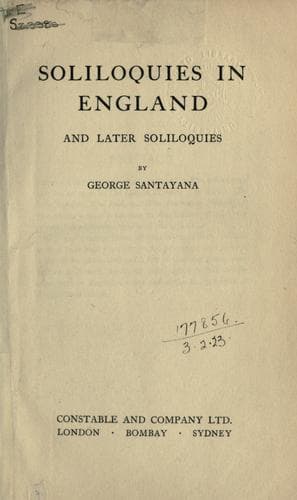
Soliloquies in England, and Later SoliloquiesSantayana, George
Philosophy
Soliloquies in England, and Later Soliloquies
Santayana, George
American essays -- 20th century
a total intellectual cramp or by a colossal folly. This thoughtful
dog has dropped the substance he held in his mouth, to snatch at the
reflection of it which his own mind gave him. It is wonderful with
what a light heart, with what self-satisfaction and even boasts, the
youngest children of the philosophical family jettison all their
heirlooms. Fichte and Nietzsche, in their fervid arrogance, could
hardly outdo the mental impoverishment of Berkeley and Hume in their
levity: it had really been a sight for the gods to see one of these
undergraduates driving matter out of the universe, whilst the other
drove out spirit.
49
THE PSYCHE
English poetry and fiction have expressed the inner man far better
than British philosophy has defined him. He is a hidden spring, a
source of bubbling half-thoughts and characteristic actions, and the
philosophers have called him a series of ideas. Ideas are rather his
weak point. Idealism, on principle, leaves no room for anything latent;
but in a living being, especially in a nice Englishman, what is latent
is the chief thing. The vital organs are under the skin and far more
complicated, I suspect, than anatomy would lead us to imagine: the case
is somewhat as if some giant in remote space should examine the surface
of our earth with a glass, measuring its motion round the sun and
perhaps round its own axis, but regarding as perfectly inexplicable and
unmeaning the coursing of ships, the march of armies and migrations,
the change of forests into cornfields, and of cornfields into deserts.
So, perhaps, far beyond the reach of any microscope, the politic
congregation of atoms within us is busy in its curiously organic and
curiously aimless way: sustaining on the whole, until disease or
death supervenes, the international peace and commerce of the animal
body. How much wireless telegraphy, how many alliances, and how many
diplomatic compromises there must be in our system for the human body
to live at all! But psychological philosophers, like children, think
the whole economy of life the simplest thing in the world: experience,
they say, just _comes_ as it does come; as the boy, asked where he
would get the money necessary for all the fine things he said he
would do when he was a man, replied, full of empirical wisdom, "Out
of my pocket, like papa!" Experience is the paternal pocket of these
philosophers; they have not discovered the financial system, the life
of the body, which fills that minute and precarious reservoir.
Public-domain text, read in full here on John Shaqi.
Reviews
Reviews
No reviews yet
Be the first to share your thoughts on this work.
Elsewhere in the archive
Join the Discussion
Join the discussion
Sign in to leave a comment or review.
Sign InorCreate an account