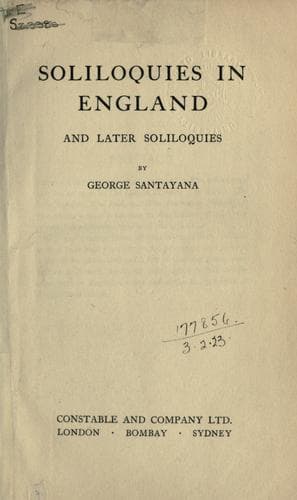
Soliloquies in England, and Later SoliloquiesSantayana, George
Philosophy
Soliloquies in England, and Later Soliloquies
Santayana, George
American essays -- 20th century
To this mysterious but evident predetermination of normal life by
the seed the ancients gave the name of soul; but to us the word soul
suggests a thinking spirit, or even a disembodied one. It is totally
incredible that a thinking spirit should exist in the seed, and should
plan and carry out (by what instruments?) the organization of the
body; and if so wise and powerful and independent a spirit lay in us
from the beginning, or rather long before our birth, how superfluous a
labour to beget us at all, and how unkind of it to dangle after it, in
addition to its own intelligence, these poor blundering and troubled
thoughts of which alone we are aware! Evidently the governing principle
in seeds is no soul in this modern sense, no thinking moral being; it
is a mysterious habit in matter. Whether this total habit is reducible
to minor habits of matter, prevalent in the world at large, is the
question debated between mechanical and vitalist psychologists; but it
is a stupid controversy. The smallest unit of mechanism is an event as
vital, as groundless, and as creative as it is possible for an event
to be; it summons fresh essences into existence, which the character
of the essences previously embodied in existence by no means implied
dialectically. On the other hand, the romantic adventure of life, if
it is not a series of miracles and catastrophes observed _ex post
facto_, must be a resultant of simpler habits struggling or conspiring
together. However minute, therefore, or however comprehensive the
units by which natural processes are described, they are equally
vital and equally mechanical, equally free and (for an observer with
a sufficient range of vision) equally predictable. On the human scale
of observation it is the larger habits of living beings that are most
easily observed; and the principle of these habits, transmitted by a
seed, I call the Psyche: it is either a complex of more minute habits
of matter, or a mastering rhythm imposed upon them by the habit of the
species. Many Greek philosophers taught that the Psyche was material;
and even Plato, although of course his Psyche might eventually take to
thinking, regarded it as primarily a principle of motion, growth, and
unconscious government; so that the associations of the word Psyche are
not repugnant, as are those of the word soul, to the meaning I wish to
give to it: that habit in matter which forms the human body and the
human mind.[1]
Public-domain text, read in full here on John Shaqi.
Reviews
Reviews
No reviews yet
Be the first to share your thoughts on this work.
Elsewhere in the archive
Join the Discussion
Join the discussion
Sign in to leave a comment or review.
Sign InorCreate an account