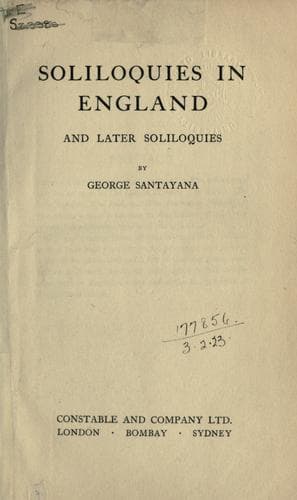
Soliloquies in England, and Later SoliloquiesSantayana, George
Philosophy
Soliloquies in England, and Later Soliloquies
Santayana, George
American essays -- 20th century
There is, then, in every man a Psyche, or inherited nucleus of life,
which from its dormant seminal condition expands and awakes anew in
each generation, becoming the person recognized in history, law, and
morals. A man's body is a sort of husk of which his Psyche (itself
material) is the kernel; and it is out of the predispositions of this
living seed, played upon by circumstances, that his character and
his mind are formed. The Psyche's first care is to surround itself
with outer organs, like a spider with its web; only these organs
remain subject to her central control, and are the medium by which
she acts upon outer things, and receives, in her patient labour, the
solicitations and rebuffs of fortune. The Psyche, being essentially
a way of living, a sort of animated code of hygiene and morals, is a
very selective principle: she is perpetually distinguishing--in action,
if not in words--between good and bad, right and wrong. Choice is the
breath of her nostrils. All the senses, instincts, and passions are
her scouts. The further she extends her influence the more she feels
how dependent she is on external things, and the more feverishly she
tries to modify them, so as to render them more harmonious with her own
impulses.
At first, when she was only a vegetative Psyche, she waited in a
comparatively peaceful mystical torpor for the rain or the sunshine
to foster her, or for the cruel winter or barbarous scythe to cut her
down; and she never would have survived at all if breeding had not been
her chief preoccupation; but she distributed herself so multitudinously
and so fast amongst her children, that she has survived to this day.
Later, she found a new means of safety and profit in locomotion; and it
was then that she began to perceive distinct objects, to think, and to
plan her actions--accomplishments by no means native to her. Like the
Chinese, she is just as busy by night as by day. Long before sunrise
she is at work in her subterranean kitchen over her pots of stewing
herbs, her looms, and her spindles; and with the first dawn, when the
first ray of intuition falls through some aperture into those dusky
spaces, what does it light up? The secret springs of her life? The aims
she is so faithfully but blindly pursuing? Far from it. Intuition,
floods of intuition, have been playing for ages upon human life: poets,
painters, men of prayer, scrupulous naturalists innumerable, have
been intent on their several visions; yet of the origin and of the
end of life we know as little as ever. And the reason is this: that
intuition is not a material organ of the Psyche, like a hand or an
antenna; it is a miraculous child, far more alive than herself, whose
only instinct is play, laughter, and brooding meditation. This strange
child--who could have been his father?--is a poet; absolutely useless
and incomprehensible to his poor mother, and only a new burden on her
shoulders, because she can't help feeding and loving him. He _sees_;
Public-domain text, read in full here on John Shaqi.
Reviews
Reviews
No reviews yet
Be the first to share your thoughts on this work.
Elsewhere in the archive
Join the Discussion
Join the discussion
Sign in to leave a comment or review.
Sign InorCreate an account