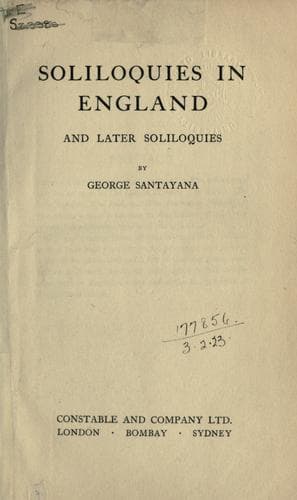
Soliloquies in England, and Later SoliloquiesSantayana, George
Philosophy
Soliloquies in England, and Later Soliloquies
Santayana, George
American essays -- 20th century
greedily like a stranger, cannot worship the world; he cannot really be
a snob. Those who have profited by a long life cannot possibly identify
the divine life with the human. They will not be satisfied with a
philosophy that is fundamentally worldly, that cannot lift up its heart
except pragmatically, because the good things are hanging from above,
or because the long way round by righteousness and the ten commandments
may be the shortest cut to the promised land. Their love of wisdom will
not be merely provisional, nor their piety a sort of idyllic interlude,
penitent but hopeful, comforting itself with the thought that the sour
grapes will soon be ripe, and oh, so delicious! They will not remember
the flesh-pots of Egypt with an eternal regret, and the flesh-pots of
Berlin and New York will not revive their appetite.
Spirit is not an instrument but a realization, a fruition. At every
stage, and wherever it peeps out through the interstices of existence,
it is a contemplation of eternal things. Eternal things are not other
material things by miracle existing for ever in another world; eternal
tilings are the essences of all things here, when we consider what
they are in themselves and not what, in the world of fortune, they may
bring or take away from us personally. That is why piety and prayer
are spiritual, when they cease to be magic operations or efforts of a
celestial diplomacy: they chief works of this school confess that this
is their only theme. Not moral life, much less the natural world, but
simply the articulation of knowledge occupies them; and yet, by the
hocus-pocus of metaphysics, they substitute this human experience for
the whole universe in which it arises. The universe is to be nothing
but a flux of perceptions, or a will positing an object, or a tendency
to feign that there is a world. It would ill become me, a pupil of this
philosophy, to deny its profundity. These are the heart-searchings of
"a creature moving about in worlds not realized." It is a wonderful
thing to spin out in soliloquy, out of some unfathomed creative
instinct, the various phases of one's faith and sensibility, making
an inventory of one's intellectual possessions, with some notes on
their presumable or reported history. I love the lore of the moral
antiquary; I love rummaging in the psychological curiosity shop. The
charm of modern life is ambiguous; it lies in self-consciousness.
Egotism has its tender developments; there is a sort of engaging purity
in its perplexities and faithful labours. The German soul has a great
volume, and Hamlet is heroic even in his impotence. When in this little
glow-worm which we call man there is so much going on, what must not
all nature contain in its immensity? Yet all these advances in analysis
and in psychological self-knowledge, far from enriching the modern
philosopher and giving him fresh hints for the interpretation of the
great world, have been neutralized, under the guise of scepticism, by
Public-domain text, read in full here on John Shaqi.
Reviews
Reviews
No reviews yet
Be the first to share your thoughts on this work.
Elsewhere in the archive
Join the Discussion
Join the discussion
Sign in to leave a comment or review.
Sign InorCreate an account