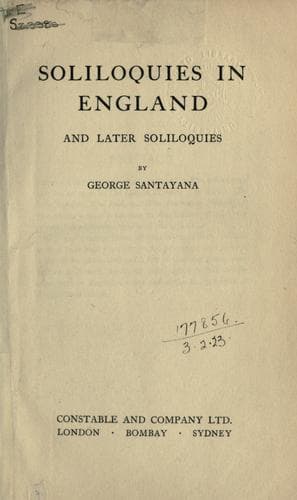
Soliloquies in England, and Later SoliloquiesSantayana, George
Philosophy
Soliloquies in England, and Later Soliloquies
Santayana, George
American essays -- 20th century
see and diffused a fragrance that eluded her. Now her warmer heart has
bred this wilder, this diviner folly: a wanton sweetness shed by her
longer travail and a flower of her old age. But he forgets her in his
selfishness, and she can never, never understand him.
[Footnote 1: I beg the learned to notice that the Psyche, as I use the
term, is not a material atom but a material system, stretching over
both time and space; it is not a monad; it has not the unity proper to
consciousness; nor is it a mass of "subconscious," mental discourse.
The Psyche may be called a substance in respect to mental and moral
phenomena which (I think) are based on modes or processes in matter,
not on any material particle taken singly; but the Psyche is not a
substance absolutely, since its own substance is matter in a certain
arrangement--in other words, body. Matter may be called mind-stuff or
psychic substance inasmuch as it can become on occasion the substance
of a Psyche, and through the Psyche the basis of mind; but of course
not in the sense that matter may be an aggregate of thinking spirits.
Mental events may be called psychic when we consider their origin
rather than their essence, as certain pleasures are called material,
although pleasures, in being, are all equally spiritual. "Psychic
phenomena" are crudely material, and "psychical research" has for its
object, not spirits in another world, but the habits of matter that
produce apparitions.]
50
REVERSION TO PLATONISM
I hear that Oxford is reading Plotinus--a blessed change from Hegel.
The pious mind is still in the age of mythology; science has confused
its own lessons, for want of a philosopher who should understand them;
and what matters, so long as the age of mythology lasts, is that the
myths that occupy the fancy should be wise and beautiful, and should
teach men to lay up their treasures in heaven. The philosophy of
Plotinus does this, and does it magnificently. Like that of Plato
and of Aristotle it is little more than a rhetorical inversion or
perpetual metaphor, expressing the aim of life under the figure of a
cosmos which is animate and which has already attained its perfection.
Considering the hurried life which we are condemned to lead, and the
shifting, symbolic ideas to which we are confined, it seems hardly
worth while to quarrel with such inspired fabulists, or to carp at the
cosmic dress in which they present their moralities. Gentle, secluded,
scholastic England does well to platonize. It had never ceased to do
so. In spite of the restiveness, sometimes, of barbarian blood, in
spite of Hebraic religion and Germanic philosophy, the great classical
tradition has always been seated here; and England has shared, even if
with a little reserve and mistrust, in the ecclesiastical, courtly,
military, and artistic heritage of Europe. A genuine child of the past,
who is bred to knowledge of the world, and does not plunge into it
Public-domain text, read in full here on John Shaqi.
Reviews
Reviews
No reviews yet
Be the first to share your thoughts on this work.
Elsewhere in the archive
Join the Discussion
Join the discussion
Sign in to leave a comment or review.
Sign InorCreate an account