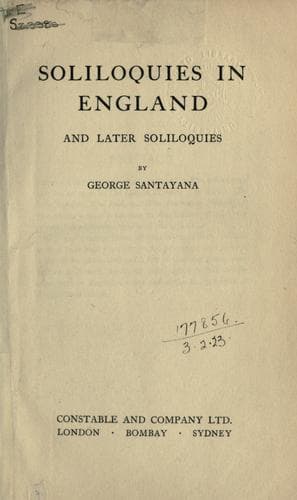
Soliloquies in England, and Later SoliloquiesSantayana, George
Philosophy
Soliloquies in England, and Later Soliloquies
Santayana, George
American essays -- 20th century
how she gave birth to such a thankless child. She hardly remembers the
warm ray from the sun or from some other celestial source which one
day pierced presents actually will be only a few, and not the most
welcome, since this world is a most paradoxical, odd, and picturesque
object, and not at all the sort of world which the human mind (being a
highly specialized part of it) would have made or can easily believe
to be real. The Ideas which a philosopher says govern the world are
not likely to be its true laws; and, if he has really drawn them from
observation, they cannot possibly be all, nor the best, Ideas on
which his free mind would have chosen to dwell. The truth, which is a
standard for the naturalist, for the poet is only a stimulus; and in
many an idealist the poet debauches the naturalist, and the naturalist
paralyses the poet. The earth might well upbraid Plato for trying to
build his seven-walled cloud-castle on her back, and to circumscribe
her in his magic circles. Why should she be forbidden to exhibit any
other essences than those authorized by this metaphysical Solon? Why
should his impoverished Olympian theology be imposed upon her, and all
her pretty dryads and silly fauns, all her harpies and chimeras, be
frowned upon and turned into black devils? How these people who would
moralize nature hate nature; and if they loved nature, how sweetly
and firmly would morality take its human place there without all this
delusion and bluster! But I am not concerned so much with the violence
done by Plato to nature; nature can take care of herself, and being
really the mother even of the most waspish philosopher, with his sting
and his wings and his buzzing, she can comfortably find room for him
and his system amongst her swarming children. I wish I knew if the
real wasps, too, have a philosophy, and what it is; probably as vital
and idealistic as that of the Germans. But I am grieved rather at the
servitude and at the stark aspect imposed on the Platonic Ideas by
their ambition to rule the world. They are like the shorn Samson in the
treadmill; they have lost the radiance and the music of Phoebus Apollo.
Socrates taught that to do wrong is to suffer harm; and his Ideas, in
establishing their absurd theocracy over nature, were compelled to bend
their backs to that earth-labour, and to become merely a celestial
zoology, a celestial grammar, and a celestial ethics. Heaven had
stooped to rule the earth, and the crooked features of the earth had
cast their grotesque shadow on heaven.
This is the first chapter in the sad history of Ideas. Now for the
second.
Public-domain text, read in full here on John Shaqi.
Reviews
Reviews
No reviews yet
Be the first to share your thoughts on this work.
Elsewhere in the archive
Join the Discussion
Join the discussion
Sign in to leave a comment or review.
Sign InorCreate an account