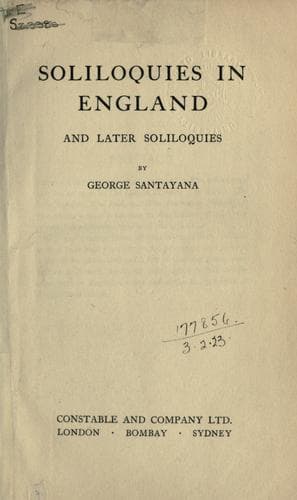
Soliloquies in England, and Later SoliloquiesSantayana, George
Philosophy
Soliloquies in England, and Later Soliloquies
Santayana, George
American essays -- 20th century
The honest Englishman does not care much for Ideas, because in his
labour, he is occupied with things and in his leisure with play, or
with rest in a haze of emotional indolence: but finding himself, for
the most part, deep in the mess of business, he is heartily desirous
of knowing the facts; and when, in his scrupulous inquiry into the
facts, he finds at bottom only Ideas, and is constrained to become a
philosopher against his will, he contrives, out of those very Ideas, to
elicit some knowledge of fact. Ideas are not intrinsically facts, but
suppositions; they are descriptions offering themselves officiously as
testimonials for facts whose character remains problematical, since, if
there were no such facts, the Ideas would still be the same; yet, says
the melancholy Jaques to himself, "Is it not a fact that I have made
this dubious supposition? Am I not entertaining this Idea? This sad but
undeniable experience of mine, not the fact which I sought nor the Idea
which I found, is the actual fact, and the undeniable existence." Thus
the occurrence of any experience, or the existence of any illusion,
assumes the names both of fact and of idea in his vocabulary, and the
existence of ideas becomes the corner-stone of his philosophy.
The most candid and delightful of English philosophers (who was an
Irishman) was Berkeley. In his ardent youth, like Plato, he awoke to
pure intuition: he saw Ideas, or at least he saw that he did not see
material things; but instead of studying these Ideas for their own sake
with a steadier gaze, he took up the disputatious notion of denying
that material things existed at all, because he could not _see_ them.
It was a great simplification; and if he had not had conventional and
apologetic axes to grind, he might have reached the radical conclusion,
familiar to Indian sages, that nothing could exist at all, least of all
himself. Language, however, and the Cartesian philosophy, made it easy
for him to assume that of course he existed, since he saw these Ideas;
and he was led by a malicious demon to add, that the Ideas existed too,
since he saw them, so long as they were visible to him. Bat if he
existed only in that he saw the Ideas, and the Ideas existed in that
he saw them, was there any difference at all between himself seeing
and the Ideas seen? None, I am afraid: so that he himself, whom he
had proudly called a spirit, would be in truth only a series of ideas
(I spell them now with a small i), and the ideas--in which he had not
stopped to recognize eternal essences--would be only the pulses of his
fugitive existence.
Public-domain text, read in full here on John Shaqi.
Reviews
Reviews
No reviews yet
Be the first to share your thoughts on this work.
Elsewhere in the archive
Join the Discussion
Join the discussion
Sign in to leave a comment or review.
Sign InorCreate an account