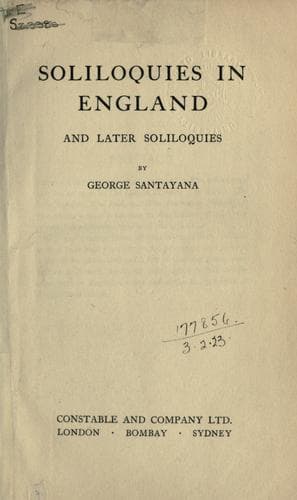
Soliloquies in England, and Later SoliloquiesSantayana, George
Philosophy
Soliloquies in England, and Later Soliloquies
Santayana, George
American essays -- 20th century
of it, and the other that matter cannot exist because it is merely an
idea which he forms. He descends to the immediate only for the sake
of the ulterior, for the immediate in some other place. If he found
himself reduced to essences actually given now, he would be terribly
unhappy, and I am sure would renounce philosophy as a bad business, as
he did in the person of Hume, his most profound representative.
Thus European speculation, like the Athalie of Racine, has twice in
its dreams beheld the same Ideas; but like that uneasy heroine it
has been troubled by the sight, and has stretched out its arms to
grasp the painted shadow. The first time, instead of Ideas, it found
a celestial hierarchy of dominations and powers, a bevy of magic
influences, angels, and demons. The second time, instead of Ideas, it
found an irrevocable flux of existing feelings, without sense, purpose,
connection, or knowledge. Perhaps if on the third occasion the Ideas
visited a less burdened and preoccupied soul, that could look on them
without apprehension, they might be welcomed for their fair aspect and
for the messages they convey from things, without being, in their own
persons, either deified or materialized.
52
THE MANSIONS OF HELEN
Concerning the visions which men have of the gods there is much
uncertainty. It is written that no man can see God and live; but I
think some evil god or evil man must be spoken of, and that they come
nearer to the truth who say that the vision of God brings perfect
happiness. I suspect this is true in a humbler and more familiar sense
than is intended in discourses about the state of the soul in heaven;
for there is a heaven above every place, and the soul mounts to it in
all its thoughts and actions, when these are perfect. I incline also
to another opinion, which would surprise those religious friends of
mine who call me an atheist; namely, that Whenever we see anything,
we have, or might have if we chose, a partial vision of God, and a
moment of happiness. For all experience comes to us fatally, from an
alien source which in physics is called matter, in morals power or
will, and in religion God; so that by his power (as I learned when a
child in my Spanish catechism) God is present in everything. The same
authority added (and how full of meaning that word is to me now!)
that he was also present in everything by his essence; since what is
brought unimpeachably before us in any vision is some essence which,
being absolutely indestructible, is in that respect divine. It is
indestructible because, if all trace and memory of it were destroyed,
it would in that very obscuration vindicate its essential identity,
since not _it_, but only things different from _it_, would now exist.
Every essence, therefore, lies eternally at the very foundations of
being, and is a part of the divine immutability and necessity; an
intrinsic feature in that Nous or Logos which theologians tell us is
the second hypostasis of the divine nature.
Public-domain text, read in full here on John Shaqi.
Reviews
Reviews
No reviews yet
Be the first to share your thoughts on this work.
Elsewhere in the archive
Join the Discussion
Join the discussion
Sign in to leave a comment or review.
Sign InorCreate an account