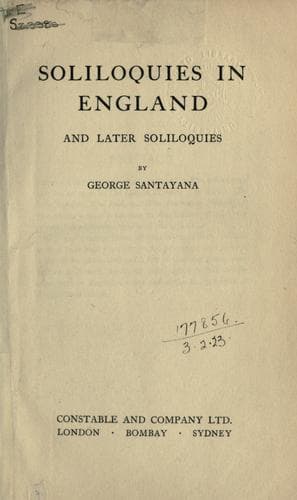
Soliloquies in England, and Later SoliloquiesSantayana, George
Philosophy
Soliloquies in England, and Later Soliloquies
Santayana, George
American essays -- 20th century
Here is substance for an excellent ironical system of the universe,
such as some philosopher in Greece might have espoused; a flux of
absolute intensive existences, variously coloured and more or less
warm, like the sparks of a rocket. Some scientific philosopher in
our day or in the future may be tempted to work out this system, and
it might have been the true one. But I see an objection to it from
the point of view of British philosophy, which covets knowledge of
fact. The philosopher conceiving this system, if the system was true,
would be only one of those sparks; he could have no idea except the
idea which he was; the whole landscape before him would be but the
fleeting nature of himself. Although, therefore, by an infinitely
improbable accident, his philosophy might be true, he could have no
reason to think it true, and no possibility of not thinking it so. A
genuine sceptic might be satisfied with this result, enjoying each
moment of his being, and laughing at his own perpetual pretension of
knowing anything further. And since extremes meet, such a mocking
sceptic might easily become, like Plato, a lover of pure Ideas. If he
really abandons all claims, all hopes, all memory which is more than
fantasy, and simply enjoys the illusion of the moment, he dwells on
an Idea, which is all that an illusion can supply. The immediate has
a mystical charm; it unveils some eternal essence, and the extreme of
renunciation, like a sacrificial death, brings a supreme security in
another sphere. Berkeley and Hume were little more than boys when they
fell in love with Ideas; perhaps, if we knew their personal history,
we should find that they were little children when they first did so,
and that pure Essence was the Beatrice that had secretly inspired all
their lives. But though they were youths of genius, there was a touch
in them of the prig; the immediate, dear as it is to fresh and honest
hearts, was too unconventional for them legally to wed and to take
home, as it were, to their worldly relations. In England to love Ideas
is to sow one's intellectual wild oats. There may be something healthy
and impetuous in that impulse which is engaging; but it must not go too
far, and above all it must not be permanent. The British philosopher
dips into idealism in order to reform belief, to get rid of dangerous
shams or uncongenial dogmas, not for the sake of pure intuition or
instant assurance. He wishes to remove impediments to action; he hates
great remote objects as he hates popery and policy; imposing things are
impositions. Better get rid, if possible, of substance and cause and
necessity and abstractions and self and consciousness. The purpose is
to reduce everything to plain experience of fact, and to rest neither
in pure intuition nor in external existences. For instance, he has
two arguments against the existence of matter which he finds equally
satisfactory: one that matter cannot exist because he can form no idea
Public-domain text, read in full here on John Shaqi.
Reviews
Reviews
No reviews yet
Be the first to share your thoughts on this work.
Elsewhere in the archive
Join the Discussion
Join the discussion
Sign in to leave a comment or review.
Sign InorCreate an account