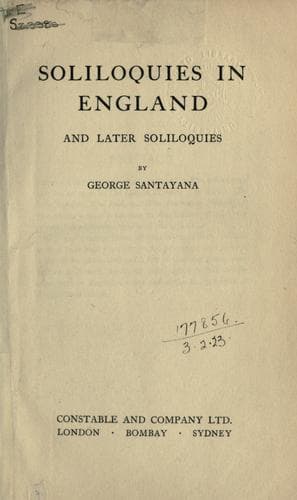
Soliloquies in England, and Later SoliloquiesSantayana, George
Philosophy
Soliloquies in England, and Later Soliloquies
Santayana, George
American essays -- 20th century
There is an obscure rumour that after the fall of Troy Helen never
returned to Sparta but was spirited away to Egypt, whilst a mere
phantasm resembling her accompanied her dull husband back to his
dull fastness by the pebbly Eurotas. This turn given to the fable
hints darkly at the unearthly truth. Helen was a phantom always and
everywhere; so long as men fought for her, taking her image, as it
were, for their banner, she presided over a most veritable and bloody
battle; but when the battle ceased of itself, and all those heroes
that had seen and idolized her were dead, the cerulean colours of that
banner faded from it; the shreds of it rotted indistinguishably in the
mire, and the hues that had lent it for a moment its terrible magic
fled back into the ether, where wind and mist, meteors and sunbeams,
never cease to weave them. The passing of Helen was the death of
Greece, but Helen herself is its immortality. Yet why seek to interpret
the parable? There is more depth of suggestion in these ancient myths
than in any abstract doctrine which we may substitute for them. Homer
and his companions certainly were not writing intentional allegories;
but they had a sense for beauty and a sense for the flux of things,
and in those two perceptions the whole philosophy of Ideas is latent.
Sight, thought, love arrest essences; and time, perpetually undermining
the existence that brings those essences before us, drives them, as
fast as we can arrest them, like a sort of upward flaw, back into
heaven.
53
THE JUDGEMENT OF PARIS
Public-domain text, read in full here on John Shaqi.
Reviews
Reviews
No reviews yet
Be the first to share your thoughts on this work.
Elsewhere in the archive
Join the Discussion
Join the discussion
Sign in to leave a comment or review.
Sign InorCreate an account