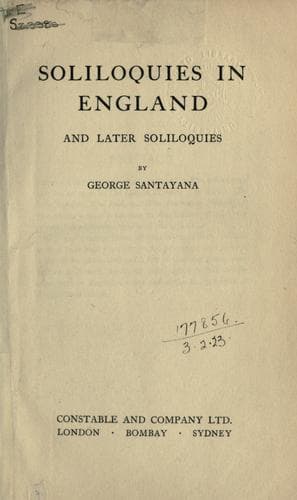
Soliloquies in England, and Later SoliloquiesSantayana, George
Philosophy
Soliloquies in England, and Later Soliloquies
Santayana, George
American essays -- 20th century
I do not conceive the Judgement of Paris as Rubens has painted it:
an agricultural labourer leering at three fat women of the town who
have gone into the country for a lark. This disrobing of goddesses,
though there may be some ancient authority for it, does not conform
to my principles of exegesis, and I pronounce it heretical. Goddesses
cannot disrobe, because their attributes are their substance. They
are like the images of the Virgin in Spanish churches; if you are so
ill-advised, you may take off their crown, their veils, and their
stiffly embroidered conical mantle; but what will remain will not be
our Lady either of Mercies or of Sorrows, but a pole, with a doll's
head and two hands attached. The spell lies in the ornaments, because
they alone are symbolical and richly mysterious. Similarly the virtue
of those pagan goddesses did not he in what each might be in herself,
either as a conscious spirit or as a beautiful titanic body endowed
with free and immortal life; their relevant virtue was tutelary,
and lay in their patronage of particular crafts or passions in man.
For this reason it was not absurd that they should be rivals in
beauty. Of course in itself every nature, celestial or even earthly,
is incomparable and perfect in its own way. But goddesses may well
compete for the prize of beauty in the eyes of a mortal; it is not
their persons that he sees or can see, but their herds, born and bred
on the mountain-side, Arcadia is full of dirt, hardship, and poverty;
sunrise and sunset are heavy to them; they fatten their sheep in order
to shear and to slaughter them, and they love a green pasture because
it fattens the sheep. So too the eclogues of town poets, and the toy
Arcadias of Versailles or of the carnival, in their satin slippers
and gilded crooks, are a forced labour, and tedious; at best a new
masquerade in which the jaded may continue to make love. But there
is a poetic Arcadia none the less, the real Arcadia mirrored in a
contemplative mind. Idle vision neither is what it looks at, nor apes
it: it is infinitely other, yet in looking forgets itself, and lends
its heart gladly to the spectacle. Paris shirked none of the labours
or bestialities of the country swain; with a semi-divine tolerance he
relished those rough sports and those monotonous pipings: anything
a creature can love, some god finds lovable. He tussled with those
wenches, and the crude scent of those smoking kettles did not turn
his stomach. Had it been less malodorous at court? Was there not more
freedom, more laughter, and greater plenty here? If Paris was not a
hero, at least he was not a snob. He was a truant prince, a fop become
a shepherd, with a body and a mind capable of great things, but doing
easy things from choice. In his very softness, since it was voluntary,
there was a kind of strength, the strength of indifference, and
freedom, and universal derision. And his cynicism was voluptuous. Idle
vision in him gilded alike everything it saw.
Public-domain text, read in full here on John Shaqi.
Reviews
Reviews
No reviews yet
Be the first to share your thoughts on this work.
Elsewhere in the archive
Join the Discussion
Join the discussion
Sign in to leave a comment or review.
Sign InorCreate an account