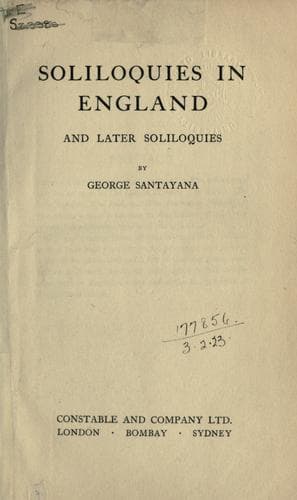
Soliloquies in England, and Later SoliloquiesSantayana, George
Philosophy
Soliloquies in England, and Later Soliloquies
Santayana, George
American essays -- 20th century
My naturalism is sometimes taxed with being dogmatic, and if I were
anxious to avoid that reproach, I might easily reduce my naturalism
to a definition and say that if experience has any sources whatever,
the sum and system of these sources shall be called nature. I know
what speculative difficulties cluster about the notion of cause, which
in one sense is quite unnecessary to science; but so long as time,
process, and derivation are admitted at all, events may be traced
back to earlier events which were their sources; and this universal
flax of events will be called nature. Any existing persons, and any
gods exercising power, will evidently be parts of nature. But I am not
concerned to avoid dogmatism on such a point. Every assertion about
existence is hazarded, it rests on animal faith, not on logical proof;
and every argument to support naturalism, or to rebut it, implies
naturalism. To deny that there are any facts (if scepticism can be
carried so far) is still to dogmatize, no less than it would be to
point to some fact in particular; in either case we descend into the
arena of existence, which may betray our confidence. Any fact is an
existence which discourse plays about and regards, but does not create.
It is the essence of the practical intellect to prophesy about nature,
and we must all do it As to the truth of our prophecy, that is always
problematical, because nature is whatever nature happens to be; and
as to our knowledge, starting as it does from a single point, the
present position of the thinker, and falling away rapidly in dearness
and certainty as the perspective recedes, it cannot pretend to draw
the outlines of nature _a priori_: yet our knowledge of nature, in our
neighbourhood and moral climate, is very considerable, since every
known fact is a part of nature. It is quite idle to deny, for instance,
that human life depends on cosmic and hygienic influences; or that in
the end all human operations must run back somehow to the rotation of
the earth, to the rays of the sun, to the moisture and fructification
of the soil, to the ferment there of vegetative and dreaming spirits,
quickened in animals endowed with locomotion into knowledge of
surrounding things: whence the passionate imaginations which we find in
ourselves. I know that things might have been arranged otherwise; and
some of those alternative worlds may be minutely thought out in myth
or in philosophy, in obedience to some dialectical or moral impulse of
the human mind; but that all those other worlds are figments of fancy,
interesting as poetry is interesting, and that only the natural world,
the world of medicine and commerce, is actual, is obvious; so obvious
to every man in his sane moments, that I have always thought it idle to
argue the point. Argument is not persuasive to madmen; but they can
be won over by gentler courses to a gradual docility to the truth. One
of these gentler courses is this: to remember that madness is human,
Public-domain text, read in full here on John Shaqi.
Reviews
Reviews
No reviews yet
Be the first to share your thoughts on this work.
Elsewhere in the archive
Join the Discussion
Join the discussion
Sign in to leave a comment or review.
Sign InorCreate an account