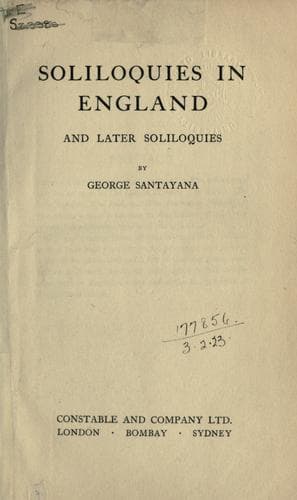
Soliloquies in England, and Later SoliloquiesSantayana, George
Philosophy
Soliloquies in England, and Later Soliloquies
Santayana, George
American essays -- 20th century
that dreams have their springs in the depths of human nature and of
human experience; and that the illusion they cause may be kindly and
even gloriously dispelled by showing what the solid truth was which
they expressed allegorically. Why should one be angry with dreams,
with myth, with allegory, with madness? We must not kill the mind, as
some rationalists do, in trying to cure it. The life of reason, as I
conceive it, is simply the dreaming mind becoming coherent, devising
symbols and methods, such as languages, by which it may fitly survey
its own career, and the forces of nature on which that career depends.
Reason thereby raises our vegetative dream into a poetic revelation
and transcript of the truth. That all this life of expression grows up
in animals living in the material world is the deliverance of reason
itself, in our lucid moments; but my books, being descriptive of the
imagination and having perhaps some touches of imagination in them, may
not seem to have expressed my lucid moments alone. They were, however,
intended to do so; and I ought to have warned my readers more often
that such was the case.
I have no metaphysics, and in that sense I am no philosopher, but
a poor ignoramus trusting what he hears from the men of science.
I rely on them to discover gradually exactly which elements in
their description of nature may be literally true, and which merely
symbolical: even if they were all symbolical, they would be true enough
for me. My naturalism is not at all afraid of the latest theories of
space, time, or matter: what I understand of them, I like, and am ready
to believe, for I am a follower of Plato in his doctrine that only
knowledge of ideas (if we call it knowledge) can be literal and exact,
whilst practical knowledge is necessarily mythical in form, precisely
because its object exists and is external to us. An arbitrary sign,
indication, or name can point to something unambiguously, without at
all fathoming its nature, and _therefore_ can be knowledge of fact:
which an aesthetic or logical elucidation of ideas can never be.
Every idea of sense or science is a summary sign, on a different plane
and scale altogether from the diffuse material facts which it covers:
one unexampled colour for many rays, one indescribable note for many
vibrations, one picture for many particles of paint, one word for a
series of noises or letters. A word is a very Platonic thing: you
cannot say when it begins, when it ends, how long it lasts, nor where
it ever is; and yet it is the only unit you mean to utter, or normally
hear. Platonism is the intuition of essences in the presence of things,
in order to describe them: it is mind itself.
Public-domain text, read in full here on John Shaqi.
Reviews
Reviews
No reviews yet
Be the first to share your thoughts on this work.
Elsewhere in the archive
Join the Discussion
Join the discussion
Sign in to leave a comment or review.
Sign InorCreate an account