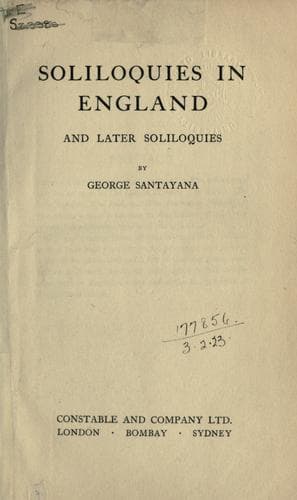
Soliloquies in England, and Later SoliloquiesSantayana, George
Philosophy
Soliloquies in England, and Later Soliloquies
Santayana, George
American essays -- 20th century
In general, I think my critics attribute to me more illusions than
I have. My dogmatism may be a fault of temper or manner, because I
dislike to stop to qualify or to explain everything; but in principle
it is raised more diffidently and on a deeper scepticism than most of
the systems which are called critical. My "essences," for instance,
are blamed for being gratuitous inventions or needless abstractions.
But essences appear precisely when all inventions are rescinded and
the irreducible manifest datum is disclosed. I do not ask any one to
_believe_ in essences. I ask them to reject every belief, and what they
will have on their hands, if they do so, will be some essence. And if,
believing nothing, they could infinitely enlarge their imagination,
the whole realm of essence would loom before them. This realm is no
discovery of mine; it has been described, for instance, by Leibniz in
two different ways; once as the collection of all possible worlds, and
again as the abyss of non-existence, _le néant_, of which he says: "The
non-existent ... is infinite, it is eternal, it has a great many of the
attributes of God; it contains an infinity of things, since all those
things which do not exist at all are included in the non-existent,
and those which no longer exist have returned to the non-existent."
It suffices, therefore, that we deny a thing for us to recognize
an essence, if we know at all what we are denying. And the essence
before us, whether we assert or deny its existence, is certainly no
abstraction; for there is no other datum, more individual or more
obvious, from which the abstraction could be drawn. The difficulty
in discerning essences is simply the very real difficulty which the
practical intellect has in abstaining from belief, and from everywhere
thinking it finds much more than is actually given.
Profound scepticism is favourable to conventions, because it doubts
that the criticism of conventions is any truer than they are. Fervent
believers look for some system of philosophy or religion that shall be
_literally_ true and worthy of superseding the current assumptions of
daily life. I look for no such thing. Never for a moment can I bring
myself to regard a human system--a piece of mental discourse--as more
than a system of notation, sometimes picturesque, sometimes abstract
and mathematical. Scientific symbols, terms in which calculation is
possible, may replace poetic symbols, which merely catch echoes of
the senses or make up dramatic units out of appearances in the gross.
But the most accurate scientific system would still be only a method
of description, and the actual facts would continue to rejoice in
their own ways of being. The relevance and truth of science, like the
relevance and truth of sense, are pragmatic, in that they mark the
actual relations, march, and distribution of events, in the terms in
which they enter our experience.
Public-domain text, read in full here on John Shaqi.
Reviews
Reviews
No reviews yet
Be the first to share your thoughts on this work.
Elsewhere in the archive
Join the Discussion
Join the discussion
Sign in to leave a comment or review.
Sign InorCreate an account