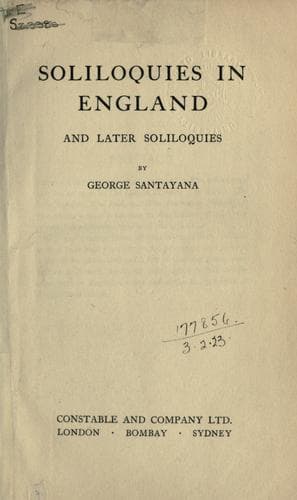
Soliloquies in England, and Later SoliloquiesSantayana, George
Philosophy
Soliloquies in England, and Later Soliloquies
Santayana, George
American essays -- 20th century
In moral philosophy (which is my chosen subject) I find my
unsophisticated readers, as I found my pupils formerly, delightfully
appreciative, warmly sympathetic, and altogether friends of mine in
the spirit. It is a joy, like that of true conversation, to look
and laugh and cry at the world so unfeignedly together. But the
other philosophers, and those whose religion is of the anxious and
intolerant sort, are not at all pleased. They think my morality very
loose: I am a friend of publicans and sinners, not (as they are) in
zeal to reform them, but because I like them as they are; and indeed
I am a pagan and a moral sceptic in my naturalism. On the other hand
(and this seems a contradiction to them), my moral philosophy looks
strangely negative and narrow; a philosophy of abstention and distaste
for life. What a horrible combination, they say to themselves, of
moral licence with moral poverty! They do not see that it is because
I love life that I wish to keep it sweet, so as to be able to love it
altogether: and that all I wish for others, or dare to recommend to
them, is that they should keep their lives sweet also, not after my
fashion, but each man in his own way. I talk a great deal about the
good and the ideal, having learned from Plato and Aristotle (since the
living have never shown me how to live) that, granting a human nature
to which to appeal, the good and the ideal may be defined with some
accuracy. Of course, they cannot be defined immutably, because human
nature is not immutable; and they cannot be defined in such a way as
to be transferred without change from one race or person to another,
because human nature is various. Yet any reflective and honest man,
in expressing his hopes and preferences, may expect to find many of
his neighbours agreeing with him, and when they agree, they may work
politically together. Now I am sometimes blamed for not labouring more
earnestly to bring down the good of which I prate into the lives of
other men. My critics suppose, apparently, that I mean by the good
some particular way of life or some type of character which is alone
virtuous, and which ought to be propagated. Alas, their propagandas!
How they have fined this world with hatred, darkness, and blood! How
they are still the eternal obstacle, in every home and in every heart,
to a simple happiness! I have no wish to propagate any particular
character, least of all my own; my conceit does not take that form.
I wish individuals, and races, and nations to be themselves, and to
multiply the forms of perfection and happiness, as nature prompts them.
The only thing which I think might be propagated without injustice to
the types thereby suppressed is harmony; enough harmony to prevent
the interference of one type with another, and to allow the perfect
development of each type. The good, as I conceive it, is happiness,
happiness for each man after his own heart, and for each hour according
to its inspiration.
Public-domain text, read in full here on John Shaqi.
Reviews
Reviews
No reviews yet
Be the first to share your thoughts on this work.
Elsewhere in the archive
Join the Discussion
Join the discussion
Sign in to leave a comment or review.
Sign InorCreate an account