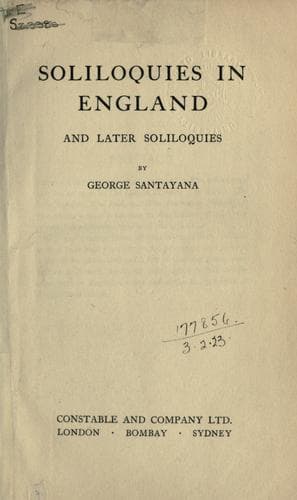
Soliloquies in England, and Later SoliloquiesSantayana, George
Philosophy
Soliloquies in England, and Later Soliloquies
Santayana, George
American essays -- 20th century
are a superb and humorous expression of it. He did not steal the
cattle of Apollo for profit. Apollo himself--a most exquisite young
god--did not give a fig for his cattle nor for his rustic employment;
in adopting it he was doing a kind turn to a friend, or had a love-lorn
scheme or a wager afoot, or merely wished for the moment to be idyllic.
It was a pleasant _scherzo_ (after the _andante_ which he played in the
heavens, in his capacity of sun-god and inspirer of all prophets) to
lean gracefully here on his herdsman's staff, or to lie under a tuft of
trees on some mossy hillock, in the midst of his pasturing kine, and to
hold the poor peeping dryads spellbound by the operatic marvels of his
singing. In purloining those oxen, Hermes, who was a very little boy at
the time, simply wanted to mock these affectations of his long-haired
elder brother; and Apollo, truly an enraptured artist and not a prig,
and invulnerable like Hermes in his godlike freedom, did not in the
least mind the practical joke, nor the ridicule, but was the first to
join in the laugh.
When Hermes consents to be the patron of thieves and money-lenders it
is in the same spirit. Standing, purse in hand, in his little shrine
above their dens, he smiles as if to remind them that everything
is trash which mortals can snatch from one another by thieving or
bargaining, and that the purpose of all their voyages, and fairs, and
high-way robberies is a bauble, such as the dirty children playing
in the street set up as a counter in their game. But Hermes is not
impatient even of the gutter-snipes, with their cries and their
shrill quarrels. He laughs at their grimaces; their jests do not seem
emptier to him than those of their elders; he is not offended at
their rags, but sends sleep to them as they lie huddled under some
archway or stretched in the sun upon the temple steps. He presides
no less benignly over thieves' kitchens and over the shipyards and
counting-houses of traders; not that he cares at all who makes the
profit or who hoards the treasure, but that sagacity and the hum of
business are delightful to him in themselves. He likes to cull the
passion and sparkle out of the most sordid life, and the confused
rumble of civilization is pleasant to his senses, like a sweet vapour
rising from the evening sacrifice.
Public-domain text, read in full here on John Shaqi.
Reviews
Reviews
No reviews yet
Be the first to share your thoughts on this work.
Elsewhere in the archive
Join the Discussion
Join the discussion
Sign in to leave a comment or review.
Sign InorCreate an account