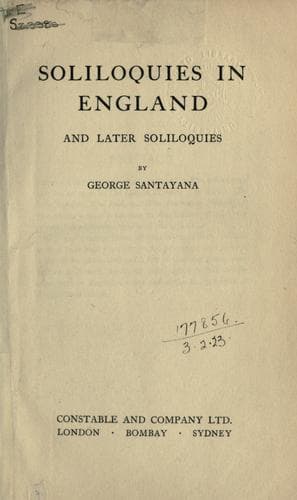
Soliloquies in England, and Later SoliloquiesSantayana, George
Philosophy
Soliloquies in England, and Later Soliloquies
Santayana, George
American essays -- 20th century
His admirable temper and mastery of soul appear in nothing more clearly
than in his love-affair with the beautiful Maia. She is ill-spoken of,
but he is very, very fond of her, and deeply happy in her love. It is
a secret relation, although everybody has heard of it; but the nymph
is a mystery; in fact, although everybody has seen her at one time
or another, no one has ever known then that it was she. Hermes alone
recognizes and loves her in her own person, and calls her by her name;
but privately. Sometimes, with that indiscretion and over-familiarity
which the young allow themselves in their cups, his brothers ask him
where he meets her; and he only smiles a little and is silent. She is
said to be a wild unmanageable being, half maenad and half shrew; a
waif always appearing and disappearing without any reason, and in her
fitful temper at once exacting and tedious. Her eyes are sometimes
blue and sometimes black, like heaven. Empty-headed and too gay, some
people think her; but others understand that she is constitutionally
melancholy and quite mad. They say she often sits alone, hardly
distinguishable in the speckled sunshine of the forest, or else by
the sea, spreading her hair to the wind and moaning: and then Hermes
flies to her and comforts her, for she is an exile everywhere and he
is everywhere at home. It is rumoured that in the East she has had a
great position, and has been Queen of the Universe; but in Europe she
has no settled metaphysical status, and it is not known whether she is
really a goddess, mistress over herself, or only a fay or a phantom
at other people's beck and call; and she has nowhere any temple or
rustic sanctuary or respectable oracle. Moreover, she has inexpressibly
shocked the virtuous, who think so much of genealogy, by saying, as
is reported, that she has no idea who is the father of her children.
Hermes laughs merrily at this, calling it one of her harmless sallies,
which she indulges in simply because they occur to her, and because
she likes to show her independence and to flout the sober censors of
this world. He is perfectly confident she has never had any wooer but
himself, nor would dream of accepting any other. Even with him she
is always reverting to stubborn refusals and denials and calling him
names; but when the spitfire is raging most angrily, he has only to
gaze at her steadily and throw his arm gaily about her, as much as to
say, "Don't be a fool," for her to be instantly mollified and confess
that it was all make-believe, but that she couldn't help it. Then it
is wonderful how reasonable she becomes, how perfectly trustful and
frank, so that no companion could be more deeply delightful. She is as
light as a feather, then, in his arms. The truth is, she lives only for
him; she really has no children, only young sisters who are also more
or less in love with him and he with them; and she sleeps her whole
life long in his absence. In all those strange doings and wanderings
Public-domain text, read in full here on John Shaqi.
Reviews
Reviews
No reviews yet
Be the first to share your thoughts on this work.
Elsewhere in the archive
Join the Discussion
Join the discussion
Sign in to leave a comment or review.
Sign InorCreate an account