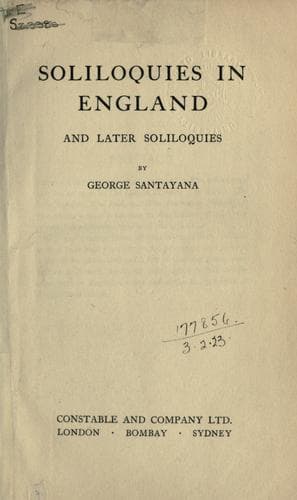
Soliloquies in England, and Later SoliloquiesSantayana, George
Philosophy
Soliloquies in England, and Later Soliloquies
Santayana, George
American essays -- 20th century
They are going to shut out from view everything except their
topmost instincts and easy habits, and to trust to luck. Yet the poor
fellows think they are safe! They think that the war--perhaps the last
of all wars--is over!
Only the dead are safe; only the dead have seen the end of war. Not
that non-existence deserves to be called peace; it is only by an
illusion of contrast and a pathetic fallacy that we are tempted to
call it so. The church has a poetical and melancholy prayer, that the
souls of the faithful departed may rest in peace. If in that sigh there
lingers any fear that, when a tomb is disturbed, the unhappy ghost is
doomed to walk more often abroad, the fear is mad; and if it merely
expresses the hope that dead men's troubles are over, the wish is
superfluous; but perhaps we may gloss the old superstition, and read
into it the rational aspiration that all souls in other spheres, or in
the world to come upon earth, might learn to live at peace with God and
with things. That would be something worth praying for, but I am afraid
it is asking too much. God--I mean the sum of all possible good--is
immutable; to make our peace with him it is we, not he, that must
change. We should need to discover, and to pursue singly, the happiness
proper to our nature, including the accidents of race and sex and the
very real advantages of growing old and of not living for ever; and we
should need to respect without envying all other forms of the good.
As to the world of existence, it is certainly fluid, and by judicious
pressure we may coax some parts of it into greater conformity with our
wills; yet it is so vast, and crawls through such ponderous, insidious
revolutions, all so blind and so inimical to one another, that in order
to live at peace with things we should need to acquire a marvellous
plasticity, or a splendid indifference. We should have to make peace
with the fact of war. It is the stupid obstinacy of our self-love that
produces tragedy, and makes us angry with the world. Free life has
the spirit of comedy. It rejoices in the seasonable beauty of each
new thing, and laughs at its decay, covets no possessions, demands no
agreement, and strives to sustain nothing in being except a gallant
spirit of courage and truth, as each fresh adventure may renew it.
Public-domain text, read in full here on John Shaqi.
Reviews
Reviews
No reviews yet
Be the first to share your thoughts on this work.
Elsewhere in the archive
Join the Discussion
Join the discussion
Sign in to leave a comment or review.
Sign InorCreate an account