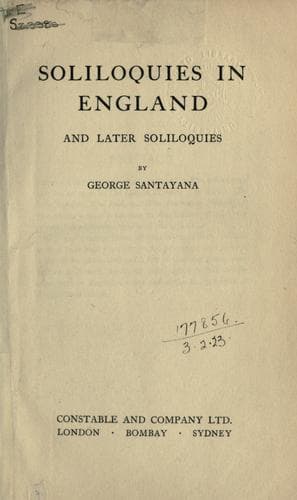
Soliloquies in England, and Later SoliloquiesSantayana, George
Philosophy
Soliloquies in England, and Later Soliloquies
Santayana, George
American essays -- 20th century
There is a poet in every nice Englishman; there is a little fund of
free vitality deep down in him which the exigencies of his life do
not tap and which no art at his command can render articulate. He
is able to draw upon it, and to drink in the refreshment and joy of
inner freedom, only in silent or religious moments. He feels he is
never so much himself as when he has shed for the time being all his
ordinary preoccupations. That is why his religion is so thin or (as
he might say) so pure: it has no relevance to any particular passions
or events; a featureless background, distant and restful, like a pale
clear sky. That is why he loves nature, and country life, and hates
towns and vulgar people; those he likes he conceives emasculated,
sentimentalized, and robed in white. The silent poet within him is
only a lyric poet. When he returns from those draughts of rare and
abstract happiness, he would find it hard to reconcile himself to the
world, or to himself, did he not view both through a veil of convention
and make-believe; he could not be honest about himself and retain his
self-respect; he could not be clear about other people and remain kind.
Yet to be kind to all, and true to his inner man, is his profound
desire; because even if life, in its unvarnished truth, is a gross
medley and a cruel business, it is redeemed for him, nevertheless, by
the perfect beauty of soul that here and there may shine through it.
Hamlet is the classic version of this imprisoned spirit; the skylark
seems a symbol of what it would be in its freedom.
Poor larks! Is the proportion of dull matter in their bodies, I wonder,
really less than in ours? Must they not find food and rear their
young? Must they not in their measure work, watch, and tremble? Cold,
hunger, and disease probably beset them more often and more bitterly
than they do most of us. But we think of them selfishly, as of actors
on the stage, only in the character they wear when they attract our
attention. As we walk through the fields we stop to watch and to listen
to them performing in the sky, and never think of their home troubles;
which they, too, seem for the moment to have eluded; at least they
have energy and time enough left over from those troubles for all this
luxury of song. It is this glorious if temporary emancipation, this
absolute defiant emphasis laid with so much sweetness on the inner life
that the poet in every nice Englishman loves in the lark; it seems to
reveal a brother-spirit more fortunate than oneself, almost a master
and a guide.
Public-domain text, read in full here on John Shaqi.
Reviews
Reviews
No reviews yet
Be the first to share your thoughts on this work.
Elsewhere in the archive
Join the Discussion
Join the discussion
Sign in to leave a comment or review.
Sign InorCreate an account