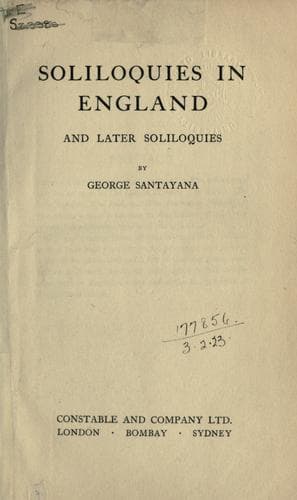
Soliloquies in England, and Later SoliloquiesSantayana, George
Philosophy
Soliloquies in England, and Later Soliloquies
Santayana, George
American essays -- 20th century
Vital raptures such as the lark's are indeed not unknown even to man,
and the suggestion of them powerfully allures the Englishman, being
as he is a youth morally, still impelled to sport, still confident of
carrying his whole self forward into some sort of heaven, whether in
love, in politics, or in religion, without resigning to nature the
things that are nature's nor hiding in God the things that are God's.
Alas, a sad lesson awaits him, if he ever grows old enough to learn
it. Vital raptures, unless long training or a miracle of adaptation
has antecedently harmonized them with the whole orchestration of
nature, necessarily come to a bad end. Dancing and singing and love
and sport and religious enthusiasm are mighty ferments: happy he who
vents them in their season. But if ever they are turned into duties,
pumped up by force, or made the basis of anything serious, like morals
or science, they become vicious. The wild breath of inspiration is gone
which hurried them across the soul like a bright cloud. Inspiration,
as we may read in Plato between the lines, inspiration is animal. It
comes from the depths, from that hearth of Hestia, the Earth-Mother,
which conservative pagans could not help venerating as divine. Only
art and reason, however, are divine in a moral sense, not because
they are less natural than inspiration (for the Earth-Mother with her
seeds and vapours is the root of everything) but because they mount
towards the ultimate heaven of order, beauty, intellectual light,
and the achievement of eternal dignities. In that dimension of being
even featherless bipeds can soar and sing with a good grace. But
space is not their element; airmen, now that we have them, are only
a new sort of sailor. They fly for the sake of danger and of high
wages; it is a boyish art, with its romantic glamour soon tarnished,
and only a material reward left for all its skill and hardships. The
only sublimity possible to man is intellectual; when he would be
sublime in any other dimension he is merely fatuous and bombastic. By
intelligence, so far as he possesses it, a man sees things as they are,
transcends his senses and his passions, uproots himself from his casual
station in space and time, sees all things future as if they were past,
and all things past as for ever present, at once condemns and forgives
himself, renounces the world and loves it. Having this inner avenue
open to divinity, he would be a fool to emulate the larks in their kind
of ecstasy.
Public-domain text, read in full here on John Shaqi.
Reviews
Reviews
No reviews yet
Be the first to share your thoughts on this work.
Elsewhere in the archive
Join the Discussion
Join the discussion
Sign in to leave a comment or review.
Sign InorCreate an account