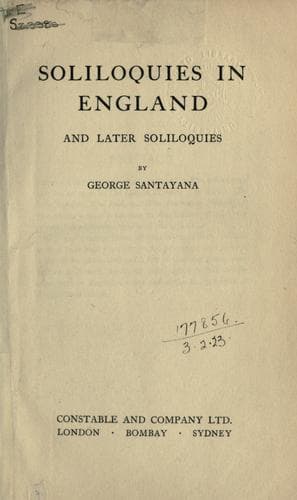
Soliloquies in England, and Later SoliloquiesSantayana, George
Philosophy
Soliloquies in England, and Later Soliloquies
Santayana, George
American essays -- 20th century
His wings are his intelligence; not that they bring ultimate success
to his animal will, which must end in failure, but that they lift his
failure itself into an atmosphere of laughter and light, where is his
proper happiness. He cannot take his fine flight, like the lark, in the
morning, in mad youth, in some irresponsible burst of vitality, because
life is impatient to begin: that sort of thing is the fluttering of
a caged bird, a rebellion against circumstance and against commonness
which is a sign of spirit, but not spirit in its self-possession, not
happiness nor a school of happiness. The thought which crowns life at
its summit can accompany it throughout its course, and can reconcile us
to its issue. Intelligence is Homeric in its pervasive light. It traces
all the business of nature, eluding but not disturbing it, rendering it
in fact more amiable than it is, and rescuing it from vanity.
Sense is like a lively child always at our elbow, saying, Look, look,
what is that? Will is like an orator, indignantly demanding something
different. History and fiction and religion are like poets, continually
recomposing the facts into some tragic unity which is not in them. All
these forms of mind are spiritual, and therefore materially superfluous
and free; but their spirit is pious, it is attentive to its sources,
and therefore seems to be care-laden and not so gloriously emancipated
as the music of larks, or even of human musicians; yet thought is pure
music in its essence, and only in its subject-matter retrospective
and troubled about the facts. It must indeed be troubled about them,
because in man spirit is not a mere truant, as it seems to be in
the lark, but is a faithful chronicler of labour and wisdom. Man is
hard-pressed; long truancies would be fatal to him. He is tempted to
indulge in them--witness his languages and pyramids and mythologies;
yet his margin of safety is comparatively narrow, and he cannot afford
to spend such relatively prodigious amounts of energy in mere play as
the lark does with a light heart and in the grand manner. There are
words to man's music; he gives names to things; he tries to catch the
rhythm of his own story, or to imagine it richer and more sublime than
it is. His festivals are heavy with pathos; they mark the events on
which his existence turns--harvests, funerals, redemptions, wooings,
and wars. When he disregards all these tiresome things, he becomes a
fop or a fanatic. There is no worthy transport for him except sane
philosophy--a commentary, not a dream. His intelligence is most intense
and triumphant when there is least waste in his life; for if hard
thinking sometimes makes the head ache, it is because it comes hard,
not because it is thinking; our fuddled brain grates and repeats
itself in that it _can't_ think. But if your business is in order, it
requires no further pains to understand it. Intelligence is the flower
of war and the flower of love. Both, in the end, are comprehension. How
Public-domain text, read in full here on John Shaqi.
Reviews
Reviews
No reviews yet
Be the first to share your thoughts on this work.
Elsewhere in the archive
Join the Discussion
Join the discussion
Sign in to leave a comment or review.
Sign InorCreate an account