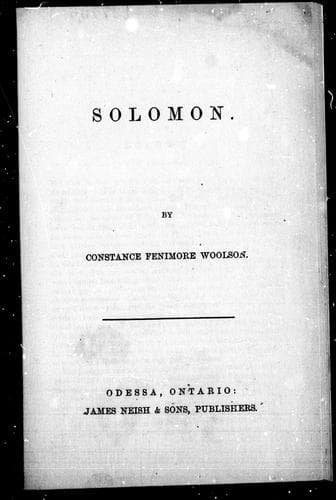
American fiction -- 19th century; Short stories, American
'Perhaps he will re-enlist, and stay three years longer,' I said.
'Ah, lady,--six year! It breaks the heart,' answered Wilhelmina.
She was the gardener's daughter, a member of the Community of German
Separatists who live secluded in one of Ohio's rich valleys, separated
by their own broad acres and orchard-covered hills from the busy world
outside; down the valley flows the tranquil Tuscarawas on its way to the
Muskingum, its slow tide rolling through the fertile bottom-lands
between stone dikes, and utilized to the utmost extent of carefulness by
the thrifty brothers, now working a saw-mill on the bank, now sending a
tributary to the flour-mill across the canal, and now branching off in a
sparkling race across the valley to turn wheels for two or three
factories, watering the great grass meadow on the way. We were floating
on this river in a skiff named by myself Der Fliegende Holländer, much
to the slow wonder of the Zoarites, who did not understand how a
Dutchman could, nor why he should, fly. Wilhelmina sat before me, her
oars trailing in the water. She showed a Nubian head above her white
kerchief: large-lidded soft brown eyes, heavy braids of dark hair,
creamy skin with, purple tints in the lips and brown shadows under the
eyes, and a far off expression which even the steady monotonous toil of
Community life had not been able to efface. She wore the blue dress and
white kerchief of the society, the quaint little calico bonnet lying
beside her; she was a small maiden; her slender form swayed in the
stiff, short-waisted gown, her feet slipped about in the broad shoes,
and her hands, roughened and browned with garden-work, were yet narrow
and graceful. From the first we felt sure she was grafted, and not a
shoot from the Community stalk. But we could learn nothing of her
origin; the Zoarites are not communicative; they fill each day with
twelve good hours of labor, and look neither forward nor back. 'She is a
daughter,' said the old gardener in answer to our questions. 'Adopted?'
I suggested; but he vouchsafed no answer. I liked the little daughter's
dreamy face, but she was pale and undeveloped, like a Southern flower
growing in Northern soil; the rosy-cheeked, flaxen-haired Rosines,
Salomes, and Dorotys, with their broad shoulders and ponderous tread,
thought this brown changeling ugly, and pitied her in their slow,
good-natured way.
'It breaks the heart,' said Wilhelmina again, softly, as if to herself.
I repented me of my thoughtlessness. 'In any case he can come back for a
few days,' I hastened to say. 'What regiment was it?'
'The One Hundred and Seventh, lady.'
I had a Cleveland paper in my basket, and taking it out I glanced over
the war-news column, carelessly, as one who does not expect to find what
he seeks. But chance was with us and gave this item: 'The One Hundred
and Seventh Regiment, O. V. I., is expected home next week. The men will
be paid off at Camp Chase.'
Public-domain text, read in full here on John Shaqi.
Reviews
Reviews
No reviews yet
Be the first to share your thoughts on this work.
Join the Discussion
Join the discussion
Sign in to leave a comment or review.
Sign InorCreate an account