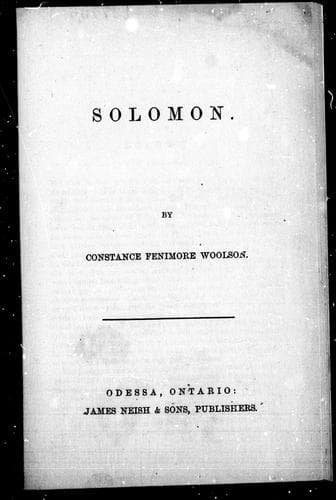
American fiction -- 19th century; Short stories, American
All the rest of the day she was like a thing possessed. I followed her
to the hill-pasture, whither she had gone to mind the cows, and found
her coiled up on the grass in the blaze of the afternoon sun, like a
little salamander. She was lost in day dreams, and the decorous cows had
a holiday for once in their sober lives, wandering beyond bounds at
will, and even tasting the dissipations of the marsh, standing unheeded
in the bog up to their sleek knees. Wilhelmina had not many words to
give me; her English vocabulary was limited; she had never read a line
of romance nor a verse of poetry. The nearest approach to either was the
Community hymn-book, containing the Separatist hymns, of which the
following lines are a specimen,
"Ruhe ist das beste Gut
Dasz man haben kann,"--
"Rest is the best good
That man can have,"--
and which embody the religious doctrine of the Zoar Brethren, although
they think, apparently, that the labor of twelve hours each day is
necessary to its enjoyment. The 'Ruhe,' however, refers more especially
to their quiet seclusion away from the turmoil of the wicked world
outside.
The second morning after this it was evident that an unusual excitement
was abroad in the phlegmatic village. All the daily duties were
fulfilled as usual at the Wirthshaus: Pauline went up to the bakery with
her board, and returned with her load of bread and bretzels balanced on
her head; Jacobina served our coffee with slow precision; and the
broad-shouldered, young-faced Lydia patted and puffed up our
mountain-high feather-beds with due care. The men went afield at the
blast of the horn, the workshops were full and the mills running. But,
nevertheless, all was not the same; the air seemed full of mystery;
there were whisperings when two met, furtive signals, and an inward
excitement glowing in the faces of men, women, and children, hitherto
placid as their own sheep. 'They have heard the news,' I said, after
watching the tailor's Gretchen and the blacksmith's Barbara stop to
exchange a whisper behind the wood-house. Later in the day we learned
that several letters from the absent soldier-boys had been received that
morning, announcing their arrival on the evening train. The news had
flown from one end of the village to the other; and although the
well-drilled hands were all at work, hearts were stirring with the
greatest excitement of a lifetime, since there was hardly a house where
there was not one expected. Each large house often held a number of
families, stowed away in little sets of chambers, with one dining-room
in common.
Public-domain text, read in full here on John Shaqi.
Reviews
Reviews
No reviews yet
Be the first to share your thoughts on this work.
Join the Discussion
Join the discussion
Sign in to leave a comment or review.
Sign InorCreate an account