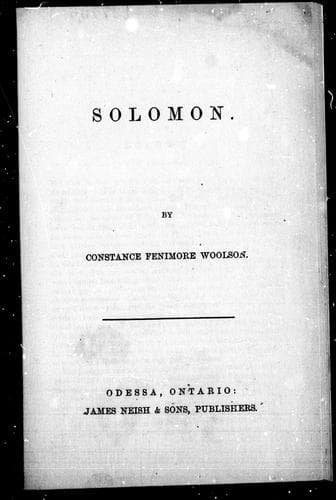
American fiction -- 19th century; Short stories, American
'Why were the Flats called St. Clair?' I said; for there is something
fascinating to me in the unknown history of the West. 'There isn't any,'
do you say? you I mean, who are strong in the Punic wars! you, too, who
are so well up in Grecian mythology. But there is history, only we don't
know it. The story of Lake Huron in the time of the Pharaohs, the story
of the Mississippi during the reign of Belshazzar, would be worth
hearing. But it is lost? All we can do is to gather together the details
of our era,--the era when Columbus came to this New World, which was,
nevertheless, as old as the world he left behind.
'It was in 1679,' began Waiting Samuel, 'that La Salle sailed up the
Detroit River in his little vessel of sixty tons burden, called the
Griffin. He was accompanied by thirty-four men, mostly fur-traders; but
there were among them two holy monks, and Father Louis Hennepin, a friar
of the Franciscan order. They passed up the river and entered the little
lake just south of us, crossing it and these Flats on the 12th of
August, which is St. Clair's day. Struck with the gentle beauty of the
scene, they named the waters after their saint, and at sunset sang a _Te
Deum_ in her honor.'
'And who was Saint Clair?'
'Saint Clair, virgin and abbess, born in Italy, in 1193, made superior
of a convent by the great Francis, and canonized for her distinguished
virtues,' said Samuel, as though reading from an encyclopædia.
'Are you a Roman Catholic?' asked Raymond.
'I am everything; all sincere faith is sacred to me,' replied the man.
'It is but a question of names.'
'Tell us of your religion,' said Raymond, thoughtfully; for in religions
Raymond was something of a polyglot.
'You would hear of my faith? Well, so be it. Your question is the work
of spirit influence. Listen, then. The great Creator has sowed immensity
with innumerable systems of suns. In one of these systems a spirit
forgot that he was a limited, subordinate being, and misused his
freedom; how, we know not. He fell, and with him all his kind. A new
race was then created for the vacant world, and, according to the fixed
purpose of the Creator, each was left free to act for himself; he loves
not mere machines. The fallen spirit, envying the new creature called
man, tempted him to sin. What was his sin? Simply the giving up of his
birthright, the divine soul-sparkle, for an earthly pleasure. The triune
divine deep, the mysterious fiery triangle, which, to our finite minds,
best represents the Deity, now withdrew his personal presence; the
elements, their balance broken, stormed upon man; his body, which was
once ethereal, moving by mere volition, now grew heavy; and it was also
appointed unto him to die. The race thus darkened, crippled, and
degenerate, sank almost to the level of brutes, the mind-fire alone
remaining of all their spiritual gifts. They lived on blindly, and as
blindly died. The sun, however, was left to them, a type of what they
had lost.
Public-domain text, read in full here on John Shaqi.
Reviews
Reviews
No reviews yet
Be the first to share your thoughts on this work.
Join the Discussion
Join the discussion
Sign in to leave a comment or review.
Sign InorCreate an account