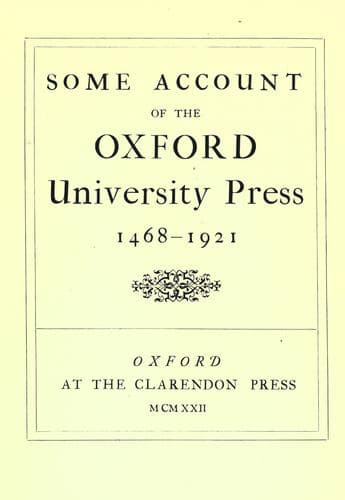
Some Account of the Oxford University Press, 1468-1921Oxford University Press
History
Some Account of the Oxford University Press, 1468-1921
Oxford University Press
Oxford University Press; Printing -- England -- Oxford -- History
For these and other reasons no proper comparison can be made with any
other English dictionary; but the magnitude of the result may none the
less be gauged by means of these. Taking one of the ten volumes as a
basis of comparison, the seventh, comprising words beginning with O and
P, has nearly 49,000 words (of which over 5,000 are obsolete and nearly
2,000 are naturalized aliens). No other English dictionary has more than
27,000 words beginning with O and P. When comparison is made of the
number of illustrative quotations, the difference is overwhelming; Vol.
VII has 175,000 quotations, and no other dictionary has much more than
20,000 for the same sections of the alphabet.
If it is thought that, great as the work is, it has taken an inordinate
time to produce, comfort may be taken from the fate of comparable
enterprises abroad. The great _Deutsches Wörterbuch_ started by the
brothers Grimm in 1838 began to be printed as long ago as 1851, and thus
had a start of over thirty years; but though it is only some two-thirds
of the scale of the Oxford book, there still after sixty-seven years
remains about a sixth to do. The Dutch _Woordenboek_ is less advanced,
and the dictionary of the Swedish Academy has not passed the letter D.
The state of the work to-day is that of the ten volumes nine are
published, and of the tenth (Ti-Z) substantial parts are complete, namely
Ti-Ty, and V, X Y Z, and the first sections of U and W. The end, however,
is not so near as might be thought; U is a large section, and W is in
many respects the most difficult letter in the alphabet, consisting as
it does almost entirely of words of Teutonic origin, and therefore of
obscure etymology and complicated history. A lexicographer makes light
work of _parallelepiped_ and _supralapsarian_; it is when he comes to
words like _wealth_ and _work_, _war_ and _waste_, _wild_ and _wilful_,
that his powers of discovery and of discrimination are seriously taxed.
Sir James Murray (he was knighted in 1908) died 26 July 1915. His
ambition to see the completion of the work on his eightieth birthday in
1917 was not fulfilled, and even if he had lived to devote to it his
amazing powers of application, could not have been fulfilled. He lived,
however, to see the end of his life-work in sight, and more than that of
any other man his name will be associated with the long and efficient
working of the great engine of research. The volumes produced by him have
characteristic excellences which cannot be exactly matched, though they
may be rivalled by merits of another kind.
Public-domain text, read in full here on John Shaqi.
Reviews
Reviews
No reviews yet
Be the first to share your thoughts on this work.
Join the Discussion
Join the discussion
Sign in to leave a comment or review.
Sign InorCreate an account