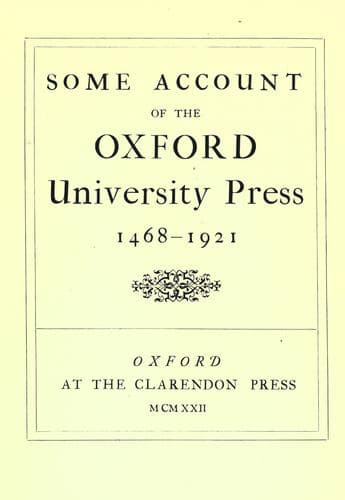
Some Account of the Oxford University Press, 1468-1921 — John Shaqi
Some Account of the Oxford University Press, 1468-1921Oxford University Press
History
Some Account of the Oxford University Press, 1468-1921
Oxford University Press
Oxford University Press; Printing -- England -- Oxford -- History
Early in the eighteenth century the Press acquired, with a new
habitation, a name still in very general use. The University was granted
the perpetual copyright of Clarendon’s _History of the Rebellion_ (a
possession in which it was confirmed by the Copyright Act of 1911); and
the _Clarendon Building_ was built chiefly from the profits accruing from
the sales of that book. Many editions were printed in folio at various
dates; and the Press Catalogue still offers the fine edition of 1849,
with the notes of Bishop Warburton, in seven volumes octavo, and that of
the _Life_ in two volumes, 1857; the whole comprising over 5,000 pages
and sold for £4 10_s._ Still cheaper is the one-volume edition of 1843,
in 1,366 pages royal octavo, the price of which is 21_s._ More recently
the demands of piety have been still further satisfied by the issue of
a new edition based on fresh collations made from the manuscript by the
late Dr. Macray. Though the Clarendon Building long since ceased to be
a printing house, one of its rooms is still _The Delegates’ Room_; and
there the Delegates of the Press hold their stated meetings.
In the eighteenth century the Bible Press grew in strength with the
co-operation of London booksellers and finally with the establishment
(in 1770, if not earlier) of its own Bible Warehouse in Paternoster
Row. The Learned Press, on the other hand, though some important books
were produced, suffered from the general apathy which then pervaded the
University. Sir William Blackstone, having been appointed a Delegate,
found that his colleagues did not meet, or met only to do nothing;
and addressed to the Vice-Chancellor a vigorous pamphlet, in which he
described the Press as ‘languishing in a lazy obscurity, and barely
reminding us of its existence, by now and then slowly bringing forth a
Program, a Sermon printed by request, or at best a Bodleian Catalogue’.
The great lawyer’s polemic gradually battered down the ramparts of
ignorant negligence, and the Press began to revive under the new statute
which he promoted. Dr. Johnson in 1767 was able to assure his sovereign
that the authorities at Oxford ‘had put their press under better
regulation, and were at that time printing _Polybius_’.
[Illustration: The Three University Presses]
The Clarendon Building is not large, and the Press very soon outgrowing
it was partly housed in various adjacent buildings, until in 1826-30
the present Press in Walton Street was erected. It is remarkable that
though the building is more like a college than a factory—it is of the
quadrangular plan regular in Oxford—and was built when printing was
still mainly a handicraft, it has been found possible to adapt its solid
fabric and spacious rooms to modern processes with very little structural
alteration. Extensive additions, however, have been and are even now
being made.
Public-domain text, read in full here on John Shaqi.
Reviews
Reviews
No reviews yet
Be the first to share your thoughts on this work.
Join the Discussion
Join the discussion
Sign in to leave a comment or review.
Sign InorCreate an account