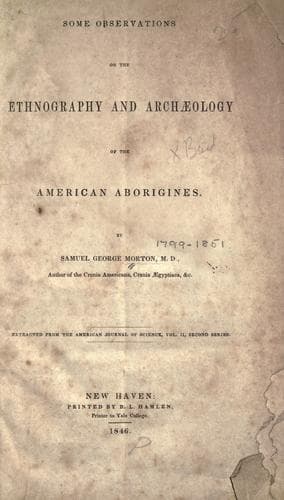
Some Observations on the Ethnography and Archaeology of the American AboriginesMorton, Samuel George
History
Some Observations on the Ethnography and Archaeology of the American Aborigines
Morton, Samuel George
Indians
[7-+] See Proceedings of the Acad. of Nat. Sciences of Phila., vol. ii,
p. 274. If I mistake not, I was the first to bring forward this _mode of
interment_ practiced by our aboriginal nations, as a strong evidence of
the unity of the American race. "Thus it is that notwithstanding the
diversity of language, customs and intellectual character, we trace this
usage throughout both Americas, affording, as we have already stated,
collateral evidence of the affiliation of all the American
tribes."--Crania Americana, p. 246, and pl. 69. Mr. Bradford in his
valuable work, _American Antiquities_, has added some examples of the
same kind; and the Chevalier D'Eichthal has also adduced this custom, in
connexion with some traces of it in Polynesia, to prove an exotic origin
for a part at least of the American race. See _Mémoires de la Société
Ethnologique de Paris_, Tome II, p. 236. Whence arose this conventional
position of the body in death? This question has been often asked and
variously answered. It is obviously an imitation of the attitude which
the living Indian habitually assumes when sitting at perfect ease, and
which has been naturally transferred to his lifeless remains as a fit
emblem of repose.
[8-*] Crania Americana, p. 116.
[8-+] I have been looking to Dr. Dickerson, of Natchez, for more
complete details derived from the tumuli of that ancient tribe which
formed a link between the Mexican nations on the one hand, and the
savage hordes on the other. Dr. Dickerson is amply provided with
interesting and important materials for this inquiry, which we trust he
will soon make public.
[8-++] The skull brought me from Ticul by Mr. Stephens, is that of a
young female. It presents the natural rounded form; which accords with
the observation of M. D'Orbigny, (L'Homme Americain,) that the
artificial moulding of the head among some tribes of Peruvians was
chiefly confined to the men.
[8-§] Travels in Central America, vol. ii, p. 311.
[9-*] Crania Americana, p. 146.
[10-*] Rambles in Yucatan, p. 216.
[10-+] Rambles by Land and Water, p. 145.
[11-*] Rambles by Land and Water, p. 203.
[12-*] Commerce of the Prairies, I, p. 165.
[12-+] Ibid. I, [TN-5] 270.
[12-++] I am aware that the walls of the ancient Mexican and Peruvian
edifices are often vertical; but where this is the case the pyramidal
form is attained by piling, one on the other, successive tiers of
masonry, each receding from the other and leaving a parapet or platform
at its base.
[13-*] Commerce of the Prairies, I, p. 277.
[14-*] See my Inquiry into the Distinctive Characteristics of the
Aboriginal Race of America, 2d edit., Philad. 1844.
[17-*] See Journal of the Antiquarian Society of Denmark, published in
Copenhagen in the Danish language, vol. i, tab. 2, figs. 52, 53.
[17-+] Jour. Acad. Nat. Sciences of Philad., vol. viii.
Transcriber's Note
The following misspellings and typographical errors were maintained.
Public-domain text, read in full here on John Shaqi.
Reviews
Reviews
No reviews yet
Be the first to share your thoughts on this work.
Join the Discussion
Join the discussion
Sign in to leave a comment or review.
Sign InorCreate an account