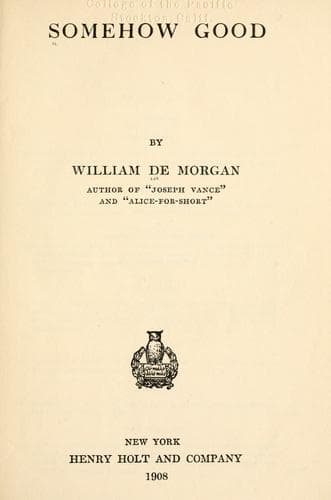
Amnesiacs -- Fiction; England -- Fiction; Mothers and daughters -- Fiction
Mrs. Wilson had a case against her husband, if not a strong one. His
ideas of the duties of a male parent were that he might incur paternity
of an indefinite number of sons and daughters, and discharge all his
obligations to them by providing their food and education. Having paid
quittance, he was at liberty to be absorbed in his books. Had his
payments been large enough to make his wife's administration of the
household easy, he might have been justified, especially as she, for
her part, was not disposed to allow him any voice in any matter.
Nevertheless, she castigated him frightfully at intervals for not
exercising an authority she was not prepared to permit. He was nothing
but a ninepin, set up to be knocked down, an Aunt Sally who was never
allowed to keep her pipe in her mouth for ten consecutive seconds. The
natural consequence of which was that his children despised him, but
to a certain extent loved him; while, on the other hand, they somewhat
disliked their mother, but (to a certain extent) respected her. It is
very hard on the historian and the dramatist that every one is not
quite good or quite bad. It would make their work so much easier. But
it would not be nearly so interesting, especially in the case of the
last-named.
The Professor may have had some feeling on these lines when he stopped
the skirts from rustling out of the apartment by a change in his
manner.
"Tell me seriously what you wish me to do, Roberta."
"I wish you to give attention, if not to the affairs--_that_ I cannot
expect--of your household, at least to this--you may call it foolish
and pooh-pooh it--business of Laetitia and this young man--I really
cannot say young gentleman, for it is mere equivocation not to call
him a haberdasher."
The Professor resisted the temptation to criticize some points of
literary structure, and accepted the obvious meaning of this.
"Tell me what he really is."
"I have told you repeatedly. He is nothing--unless we palter with the
meaning of words--but a clerk in the office at the stores where we pay
a deposit and order goods on a form. They were originally haberdashers,
so I don't see how you can escape from what I have said. But I have
no doubt you will try to do so."
"How comes he to be such a magnificent violinist? Are they all...?"
"I know what you are going to say, and it's foolish. No, they are not
all magnificent violinists. But you know the story quite well."
"Perhaps I do. But now listen. I want to make out one thing. This
young man talked quite freely to me and Egerton about his place, his
position, salary--everything. And yet you say he isn't a gentleman."
"Of course he isn't a gentleman. I don't the least understand what
you mean. It's some prevarication or paradox." Mrs. Wilson taps the
chair-arm impatiently.
"I mean this--if he isn't a gentleman, how comes it that he isn't
ashamed of being a haberdasher? Because he _isn't_. Seemed to take
it all as a matter of course."
Public-domain text, read in full here on John Shaqi.
Reviews
Reviews
No reviews yet
Be the first to share your thoughts on this work.
Elsewhere in the archive
Join the Discussion
Join the discussion
Sign in to leave a comment or review.
Sign InorCreate an account