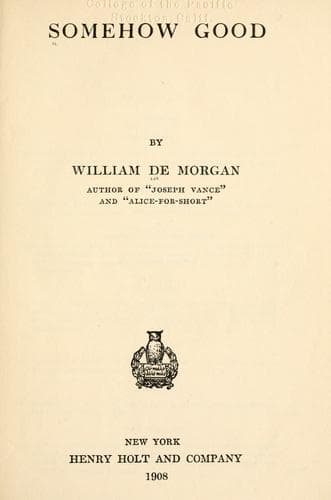
Amnesiacs -- Fiction; England -- Fiction; Mothers and daughters -- Fiction
"I cannot follow your meaning at all. And I will not trouble you to
explain it. The question now is--will you, or will you not, _do_
something?"
"Has the young gentleman?"--Mrs. Wilson snorted audibly--"Well, has
this young haberdasher made any sort of definite declaration to
Laetitia?"
"I understand not. But it's impossible not to see."
"Would it not be a little premature for me to say anything to him?"
"Have I asked you to do so?"
"I am a little uncertain what it is you have asked me to do."
Mrs. Wilson contrived, by pantomime before she spoke, to express her
perfect patience under extremest trial, inflicted on her by an impudent
suggestion that she hadn't made her position clear. She would, however,
state her case once more with incisive distinctness. To that end she
separated her syllables, and accented selections from them, even as
a resolute hammer accents the head of a nail.
"Have I not told you dis_tinct_ly"--the middle syllable of this word
was a sample nailhead--"a _thou_sand times that what I wish you to
do--however much you may shirk doing it--is to _speak_ to Laetitia--to
remonstrate with her about the encouragement she is giving to this
young man, and to _point out_ to her that a girl in her position--in
short, the duties of a girl in her position?" Mrs. Wilson's come-down
at this point was an example of a solemn warning to the elocutionist
who breaks out of bounds. She was obliged to fall back arbitrarily on
her key-note in the middle of the performance. "Have I said this to
you, Mr. Wilson, or have I not?"
"Speaking from memory I should say _not_. Yes--certainly _not_. But
I can raise no reasonable objection to speaking to Laetitia, provided
I am at liberty to say what I like. I understand that to be part of
the bargain."
"If you mean," says the lady, whose temper had not been improved by the
first part of the speech; "if you mean that you consider yourself at
liberty to encourage a rebellious daughter against her mother, I know
too well from old experience that that is the case. But I trust that
for once your right feeling will show you that it is your _plain duty_
to tell her that the course she is pursuing can only lead to the loss
of her position in society, and probably to poverty and unhappiness."
"I can tell her you think so, of course," says the Professor, drily.
"I will say no more"--very freezingly. "You know as well as I do what
it is your _duty_ to say to your daughter. What you will _decide_
to say, I do _not_ know." And premonitory rustles end in a move to
the door.
"You can tell her to come in now--if you like." The Professor won't
show too vivid an interest. It isn't as if the matter related to a
Scythian war-chariot, or a gold ornament from a prehistoric tomb, or
_variae lectiones_.
Public-domain text, read in full here on John Shaqi.
Reviews
Reviews
No reviews yet
Be the first to share your thoughts on this work.
Elsewhere in the archive
Join the Discussion
Join the discussion
Sign in to leave a comment or review.
Sign InorCreate an account