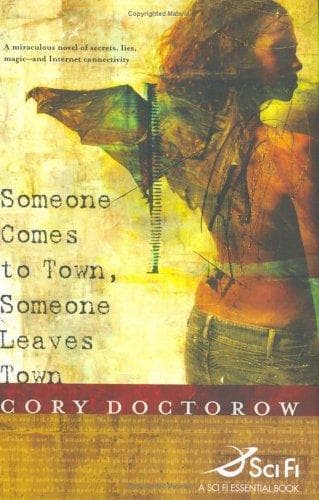
Someone Comes to Town, Someone Leaves TownDoctorow, Cory
Science
Someone Comes to Town, Someone Leaves Town
Doctorow, Cory
Internet -- Fiction; Science fiction; Toronto (Ont.) -- Fiction
She didn't speak much English, so I grew up speaking a creole of
Russian, Ukrainian, Polish and English, and I used my words to ask her,
with more and more insistence, when I'd get to go to class.
I couldn't read or write, and neither could she. But I could take apart
gadgets like nobody's business. Someone -- maybe Auntie's long dead
husband -- had left her a junky tool kit with cracked handles and
chipped tips, and I attacked anything that I could get unplugged from
the wall: the big cabinet TV and radio, the suitcase record player, the
Sputnik music box. I unwired the lamps and peered at the workings of the
electric kitchen clock.
That was four. Five was the year I put it all back together again. I
started with the lamps, then the motor in the blender, then the toaster
elements. I made the old TV work. I don't think I knew how any of it
*really* worked -- couldn't tell you a thing about, you know, electrical
engineering, but I just got a sense of how it was *supposed* to go
together.
Auntie didn't let me out of the apartment after five. I could watch the
kids go by from the window -- skinny Hasids with side-curls and
Filipinos with pretty ribbons and teenagers who smoked, but I couldn't
go to them. I watched *Sesame Street* and *Mr. Dressup* and I began to
soak up English. I began to soak up the idea of playing with other kids.
I began to soak up the fact that none of the kids on the TV had wings.
Auntie left me alone in the afternoons while she went out shopping and
banking and whatever else it was she did, and it was during those times
that I could get myself into her bedroom and go rooting around her
things.
She had a lot of mysterious beige foundation garments that were utterly
inexplicable, and a little box of jewelry that I liked to taste, because
the real gold tasted really rich when I sucked on it, and a stack of old
cigarette tins full of frayed photos.
The pictures were stiff and mysterious. Faces loomed out of featureless
black backgrounds: pop-eyed, jug-eared Russian farm boys, awkward farm
girls with process waves in their hair, everyone looking like they'd
been stuffed and mounted. I guess they were her relatives, because if
you squinted at them and cocked your head, you could kind of see her
features in theirs, but not saggy and wrinkled and three-chinned, but
young and tight and almost glowing. They all had big shoulders and
clothing that looked like the kind of thing the Hasids wore, black and
sober.
The faces were interesting, especially after I figured out that one of
them might belong to Auntie, but it was the blackness around them that
fascinated me. The boys had black suits and the girls wore black
dresses, and behind them was creased blackness, complete darkness, as
though they'd put their heads through a black curtain.
Public-domain text, read in full here on John Shaqi.
Reviews
Reviews
No reviews yet
Be the first to share your thoughts on this work.
Elsewhere in the archive
Join the Discussion
Join the discussion
Sign in to leave a comment or review.
Sign InorCreate an account