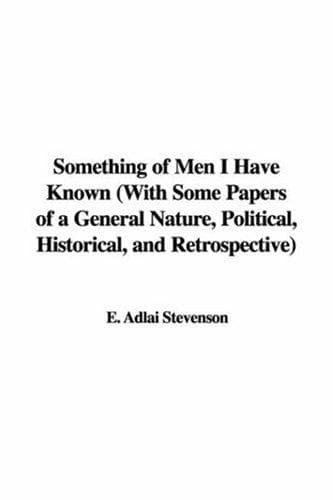
Something of Men I Have Known: With Some Papers of a General Nature, Political, Historical, and RetrospectiveStevenson, Adlai E. (Adlai Ewing)
History
Something of Men I Have Known: With Some Papers of a General Nature, Political, Historical, and Retrospective
Stevenson, Adlai E. (Adlai Ewing)
United States -- Biography; United States -- Politics and government -- 1865-1933
The keen sense of the humorous, with which Mr. Lincoln was so
abundantly gifted, seems not to have wholly deserted him even in
the serious moments when penning an acceptance to mortal combat.
The terms of meeting indicated--which he as the challenged party
had the right to dictate--lend color to the opinion that he regarded
the affair in the light of a mere farce. His superior height
and length of arm remembered, and the position of the less favored
Shields, with broadsword in hand, at the opposite side of the board,
and not permitted "upon forfeit of his life" to advance an inch
--the picture is indeed a ludicrous one.
Out of the lengthy statements of the respective seconds--the
publication of which came near involving themselves in personal
altercation--it appears that all parties actually reached the
appointed rendezvous on time.
But it was not written in the book of fate that this duel was to
take place. Something of mightier moment was awaiting one of
the actors in this drama. Two level-headed men, R. W. English and
John J. Hardin, the friends respectively of Shields and Lincoln,
crossing the Mississippi in a canoe close in the wake of the
belligerents, reached the field just before the appointed hour.
These gentlemen, acting in concert with the seconds, Whiteside and
Merryman, soon effected a reconciliation deemed honorable to all, and
the Shields-Lincoln duel passed to the domain of history. That
the reconciliation thus brought about was sincere was evidenced by
the fact that one of the earliest acts of President Lincoln was
the appointment of General Shields to an important military command.
How strangely "the whirligig of time brings in his revenges!" A
few paces apart in the old Hall at the Capitol at Washington, stand
two statues, the contribution of Illinois for enduring place in
the "Temple of the Immortals." One is the statue of Lincoln,
the other that of Shields.
XI
A PRINCELY GIFT
DESCENT OF JAMES SMITHSON, FOUNDER OF THE SMITHSONIAN INSTITUTION--
HIS EDUCATION AND HIS WRITINGS--HIS WILL--THE UNITED STATES HIS
RESIDUARY LEGATEE--SUCCESSFUL PROSECUTION OF THE CLAIM OF THE UNITED
STATES TO THE LEGACY--PLANS SUGGESTED FOR THE DISPOSAL OF THE FUND
--PROF. JOSEPH HENRY APPOINTED SECRETARY--BENEFICENT WORK OF THE
INSTITUTION.
Although a third of a century has passed since I met Professor
Joseph Henry, I distinctly recall his kindly greeting and the
courteous manner in which he gave me the information I requested
for the use of one of the Committees of the House.
The frosts of many winters were then on his brow, and he was near the
close of an honorable career, one of measureless benefit to mankind.
He was the first secretary of the Smithsonian Institution, and the
originator of the plan by which was carried into practical effect the
splendid bequest for "the increase and diffusion of knowledge among
men."
Public-domain text, read in full here on John Shaqi.
Reviews
Reviews
No reviews yet
Be the first to share your thoughts on this work.
Elsewhere in the archive
Join the Discussion
Join the discussion
Sign in to leave a comment or review.
Sign InorCreate an account