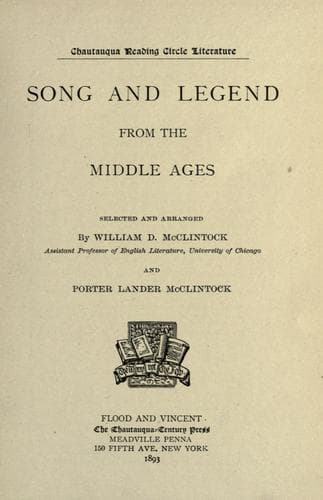
Literature, Medieval -- History and criticism; Literature, Medieval -- Translations into English
Reynard the Fox thought, "how came I on this company? We been not
both alike.[1] I shall not well con[2] stand against this strong
thief. All my proof is now come to an end."
[1] Of equal strength. [2] Know how to.
Yet, thought the fox, "I have good advantage. The claws of his
fore feet been off and his feet been yet sore thereof, when for
my sake he was unshod. He shall be somewhat the weaker."
Then said the fox, "who that sayeth that I am a traitor or a
murderer? I say he lieth falsely, and that art thou especially
Isegrym. Thou bringest me there as I would be. This have I oft
desired. Lo! there is my pledge that all thy words been false and
that I shall defend me and make good that thou liest.
The king received the pledges and amitted[1] the battle, and
asked borrows[2] of them both, that on the morn they should come
and perform their battle and do as they ought to do. Then the
Bear and the Cat were borrows for the wolf, and for the Fox were
borrows Grymbert,[3] the dasse,[4] and Bytelnys.[5]
[1] Admitted. [2] Pledges. [3] The badger. [4] A small fox. [5]
The elder daughter of the apes.
TALES.
French mediaeval literature includes many tales less elaborate in
form and less "heroic" in subject than the epics and romances and
without the satire and humor of the fables. The best of them are
the love stories, and of these the most beautiful is "Aucassin
and Nicolette", by an unknown trouvere of the thirteenth century.
It is an alternation of prose narrative and dainty narrative
lyrics. The story is that of two lovers parted temporarily by the
pride and cruelty of the youth's father. But, remaining true to
each other, they are, after many vicissitudes, happily united.
Our extracts are from Bourdillon's beautiful translation.
FROM AUCASSIN AND NICOLETTE.
Sec. 1.--
Who were fain good verse to hear,
Of the aged captives' cheer,
Of two children fair and feat,
Aucassin and Nicolette,--
What great sorrows suffered he,
And what deeds did valiantly
For his love, so bright of blee?
Sweet the song, and fair the say,
Dainty and of deft array.
So astonied wight is none,
Nor so doleful nor undone,
None that doth so sorely ail,
If he hear, shall not be hale,
And made glad again for bliss,
So sweet it is!
The hero refuses to become a knight and go to war unless his
father will give him Nicolette for wife.
Sec. 8.--
Aucassin was of Beaucaire,
And abode in castle fair.
None can move him to forget
Dainty-fashioned Nicolette
Whom his sire to him denies;
And his mother sternly cries:
"Out on thee! what wilt thou, loon?
Nicolette is blithe and boon?
Castaway from Carthage she!
Bought of Paynim compayne!
If with woman thou wilt mate,
Take thee wife of high estate!"
"Mother, I can else do ne'er!
Nicolette is debonair;
Her lithe form, her face, her bloom,
Do the heart of me illume.
Fairly mine her love may be
So sweet is she!"
Public-domain text, read in full here on John Shaqi.
Reviews
Reviews
No reviews yet
Be the first to share your thoughts on this work.
Join the Discussion
Join the discussion
Sign in to leave a comment or review.
Sign InorCreate an account