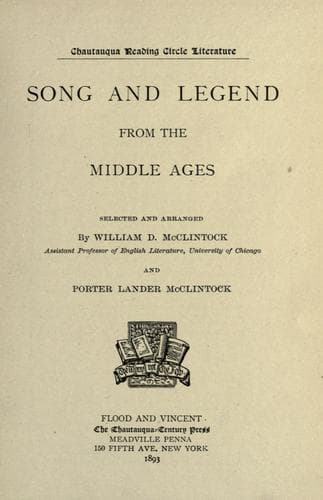
Literature, Medieval -- History and criticism; Literature, Medieval -- Translations into English
NOTE.--These extracts from Chaucer's translation are not
re-translated nor adapted. Chaucer's words are retained in every
case. Their spelling is modernized. In those cases in which they
needed for the rhythm, certain inflectional endings, e, en, es,
are retained and are printed in parentheses. The reader has only
to remember that he must pronounce every syllable needed to make
the lines rhythmical. In only four cases has the rhyme been
affected by the changed spelling. For defense of this modern
spelling of Chaucer, the reader is referred to Lounsbury's
"Studies in Chaucer," Vol. III., pp. 264-279.
Ll. 49-91.--
That it was May me thought(e) tho[1]
It is five year or more ago;
That it was May, thus dreamed me,
In time of love and jollity.
That all thing 'ginneth waxen gay,
For there is neither busk nor hay[2]
In May, that it nill[3] shrouded been
And [4] it with new(e) leaves wrene[5]
These wood(e)s eek recover green,
That dry in winter been to seen;[6]
And the earth waxeth proud withal
For sweet dews that on it fall.
And the poor estate forget
In which that winter had it set.
And then becometh the ground so proud,
That it will have a new(e) shroud,
And maketh so quaint his robe and fair
That it had hews an hundred pair,
Of grass and flowers, inde and perse[7]
And many hew(e)s full diverse:
That is the robe, I mean, ivis,[8]
Through which the ground to praise(n)[9] is.
The birds that have(n) left their song,
While they have suffered cold so strong,
In weathers grill [10] and dark to sight,
Ben [11] in May for [12] the sun(en) bright
So glad(e), that they show in singing
That in (t)heir hearts is such liking,[13]
That they mote [14] sing(en) and be light.
Then doth the nightingale her might
To make noise and sing(en) blithe,
Then is bussful many sithe,[15]
The calandra [16] and the popinjay.[17]
Then young(e) folk entend(en)[18] aye
For to be gay and amorous,
The time is then so favorous.[19]
Hard is the heart that loveth nought,
In May when all this mirth is wrought:
When he may on these branches hear
The small(e) bird(e)s sing(en) clear
(T)heir blissful' sweet song piteous,
And in this season delightous[20]
When love affrayeth[21] all(e) thing.
[1] Then. [2] Bush nor hedge. [3] Will not. [4] As if. [5] Were
covered. [6] Are to be seen. [7] Azure and sky-colored. [8]
Certainly. [9] To be praised. [10] Severe. [11] Are. [12] On
account of. [13] Good bodily condition. [14] Must. [15] Times.
[16] A kind of lark. [17] Parrot. [18] Attend. [19] Favorable.
[20] Delightful. [21] Moveth.
The poet sees in vision the Garden of Love. He knocks at "a wiket
smalle," which was finally opened by a maiden.
Public-domain text, read in full here on John Shaqi.
Reviews
Reviews
No reviews yet
Be the first to share your thoughts on this work.
Join the Discussion
Join the discussion
Sign in to leave a comment or review.
Sign InorCreate an account